Diamond Education
The 4 Cs
The universal language for grading a diamond — Cut, Colour, Clarity and Carat. Learn what each one truly means so you can browse our collection with confidence and choose a stone you'll love for a lifetime.
01 / The 4 Cs
Cut
The spark above all
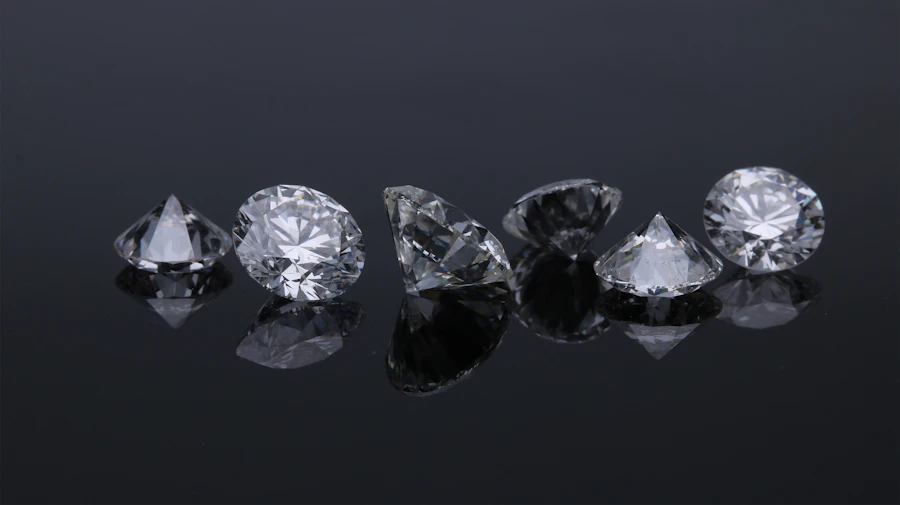
Cut is the most important of the 4Cs. It governs how the facets interact with light, producing a diamond's brilliance (white light return), fire (rainbow dispersion) and scintillation (sparkle). Grades run Excellent → Very Good → Good → Fair.
An Excellent cut of lower colour and clarity will always out-sparkle a poorly cut flawless stone. Prioritise cut first — it is the single factor you can feel across a room.
What to remember
- Choose Excellent or Very Good for maximum sparkle
- Cut affects how large a stone faces up — a well-cut stone appears bigger
- Poorly cut stones look dull even when colour and clarity are perfect
02 / The 4 Cs
Colour
The whiter the rarer
Diamond colour is graded D (colourless) to Z (light yellow or brown). The less colour, the rarer and more valuable the stone. D–F are colourless; G–J are near-colourless and offer superb value once set.
Most people cannot distinguish two adjacent grades once a diamond is mounted, so a G or H is a savvy sweet spot — icy white to the eye, noticeably better value than D–F.
What to remember
- D–F colourless — the rarest and most expensive
- G–J near-colourless — excellent value once set in metal
- Yellow gold settings tolerate warmer colour grades beautifully
03 / The 4 Cs
Clarity
The natural fingerprint
Clarity measures natural inclusions and surface blemishes on a scale from FL (flawless) to I3. Most inclusions are microscopic. VS and SI grades are typically "eye-clean" — invisible to the naked eye.
A well-placed SI stone can be completely eye-clean, so you get the same visual purity as a flawless grade for far less. Step cuts (emerald, asscher) reveal inclusions, so choose VS or higher for those.
What to remember
- VS1–VS2: the safe, eye-clean sweet spot
- SI1–SI2: often eye-clean in brilliant cuts — superb value
- Only flawless grades are truly inclusion-free under magnification
04 / The 4 Cs
Carat
Weight, not size
Carat measures a diamond's weight — one carat equals 0.2 grams. Larger diamonds are rarer, so price rises steeply with size. Carat is weight, not visible size: a well-cut stone faces up larger than a poorly cut one of the same weight.
Because pricing jumps at "magic" thresholds (0.50, 0.75, 1.00, 1.50, 2.00 carats), buying just under — for example 0.95ct instead of 1.00ct — can save significantly with no visible difference.
What to remember
- Cut and shape affect visible size more than carat alone
- Buy just under "magic" thresholds to save on a stone that looks identical
- Two smaller stones can out-sparkle one large one of the same total weight
Putting it together
How to balance the 4 Cs
No single grade defines a beautiful diamond — it is the balance that matters. As a rule of thumb: prioritise Cut first for sparkle, then balance Colour and Clarity to your eye, and finally choose the Carat weight that fits your budget and your setting.
If budget is tight
Excellent cut, G–H colour, SI1 clarity, just under a magic carat — beautiful to the eye and excellent value.
If you want max sparkle
Excellent cut first; allow colour to drop to H–I and clarity to VS2–SI1 — the cut carries the show.
If you want rarity
Pursue D–F colour and VS1 or higher clarity once cut is Excellent — the rare combination, for those who want the pinnacle.
Watch & learn
See the 4 Cs come to life
Reading about cut, colour, clarity and carat is one thing — seeing how light moves through a well-cut diamond is another. Watch how brilliance, fire and scintillation reveal themselves as the stone turns.
Look for the white flashes (brilliance), the rainbow bursts (fire), and the dance of light as the diamond moves (scintillation) — that\'s cut doing its work.
Take it with you
The 4 Cs Cheat-Sheet
A one-page summary to keep handy while you browse. Print it off or save it for your consultation.
Cut
Grades
Excellent → Very Good → Good → Fair
What to remember
Prioritise first — it drives brilliance, fire & sparkle. An Excellent cut of lower colour/clarity outshines a poorly cut flawless stone.
Sweet spot
Excellent or Very Good
Colour
Grades
D (colourless) → Z (light yellow)
What to remember
Less colour = rarer. Most can't tell adjacent grades once set. G–H is the icy-white value sweet spot.
Sweet spot
G–H in white gold; I–J in yellow gold
Clarity
Grades
FL → IF → VVS1/2 → VS1/2 → SI1/2 → I1/2/3
What to remember
Most inclusions are microscopic. VS and eye-clean SI grades look identical to flawless to the naked eye.
Sweet spot
VS2 or eye-clean SI1 (VS+ for step cuts)
Carat
Grades
1 carat = 0.2 grams (weight, not size)
What to remember
Price jumps at "magic" sizes (0.50, 0.75, 1.00, 1.50, 2.00). Buy just under to save with no visible difference.
Sweet spot
0.90–0.95ct instead of 1.00ct
Jewellove · Master Jewellers, Blantyre
GIA · IGI · HRD certified diamonds
Put the 4 Cs into practice
Find Your Diamond
Now you know the 4 Cs — use them to filter our certified collection. Adjust carat, cut, colour and clarity to find the stone that's right for you.
Carat · 0.00ct – 5.00ct
Cut Grade
Colour · D–M
Clarity · FL–I1
28 diamonds found
Test your knowledge
The 4 Cs Quiz
1 / 5
Which of the 4 Cs has the biggest impact on a diamond's sparkle?
Score: 0 / 5
Ready to find your diamond?
Every diamond in our collection is GIA, IGI or HRD certified, with the 4 Cs clearly listed so you can compare side by side.