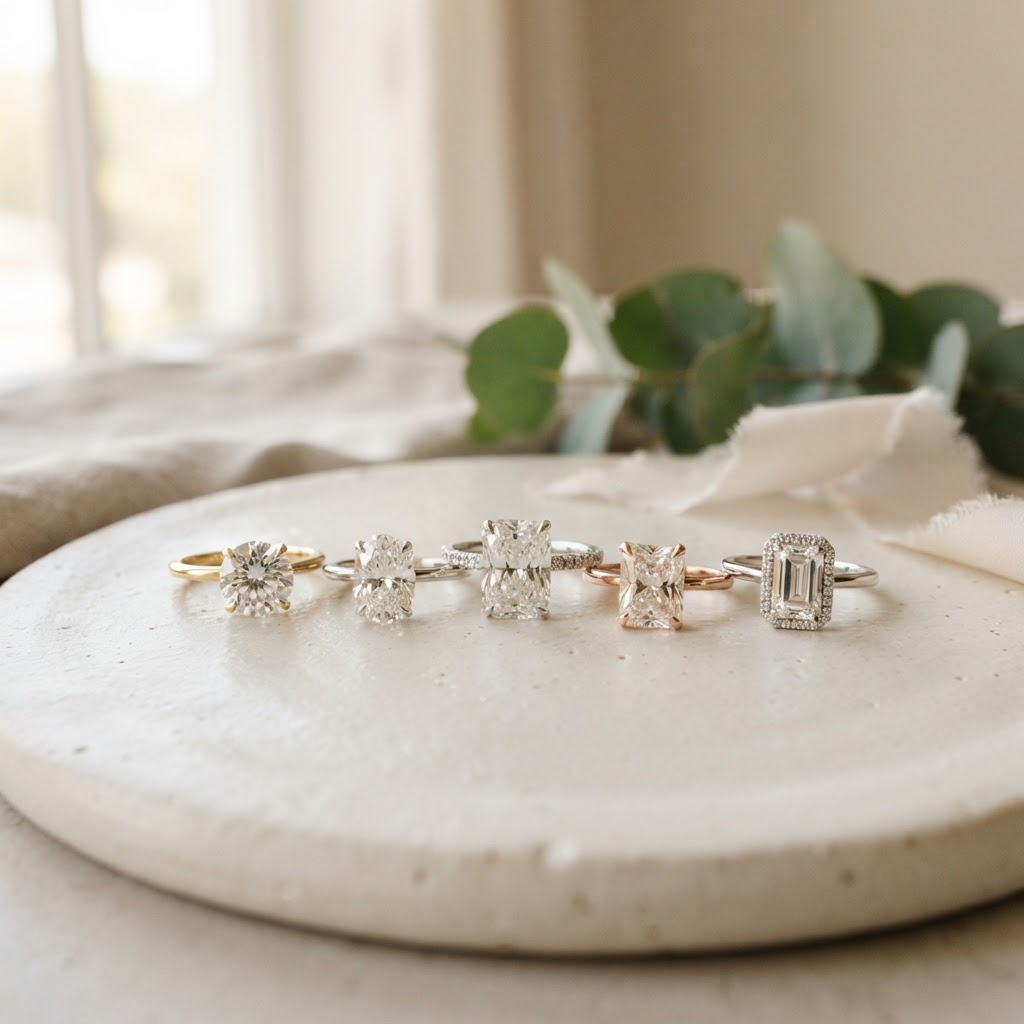
Choose a Diamond Shape for Your Engagement Ring
The most popular diamond shape isn’t automatically the best fit. Choose according to the outline you prefer, how it appears on the finger and whether...
The most popular diamond shape isn’t automatically the best fit. Choose according to the outline you prefer, how it appears on the finger and whether you favour bright flashes or softer reflections. A round brilliant has 57 or 58 facets, but its facet pattern is only one part of how a diamond looks.
It’s reasonable to start with a shape that catches your eye. Then compare how different outlines affect the appearance of the finger and how each shape displays light. This guide to choosing a diamond shape explains those differences, including why elongated options such as oval, pear and marquise can create a lengthening effect.
You’ll also learn how shape differs from cut, what to look for when comparing proportions, and how to match a diamond’s outline to your engagement ring preferences. Use these points to narrow your options and make a more informed comparison.
Key Takeaways
- Compare the outline you prefer with how each shape displays light; a round brilliant is designed for symmetrical brilliance, while step cuts show more subtle flashes.
- Consider elongated shapes such as oval, pear and marquise if you want a finger-lengthening effect, and compare their proportions and orientation.
- Distinguish shape, the diamond’s outline, from cut, which describes its proportions and interaction with light.
- Look beyond carat weight when comparing stones: table spread can affect how large a diamond appears, while a bow-tie effect may be visible in some elongated shapes.
- Use your preferred look, finger appearance and light pattern to narrow the options before matching a diamond to an engagement ring.
Which diamond shape to choose?
Start with the outline you prefer, then compare how its facets handle light and how its measurements look at a given carat weight. A choosing a diamond shape guide is most useful when it helps you weigh these features, rather than treating one shape as the automatic choice.
Round brilliance and popularity
A round brilliant is a circular diamond cut to return light through a symmetrical facet pattern. It remains a popular engagement-ring choice, with round diamonds used across the 19th, 20th and 21st centuries. The standard round brilliant has 57 or 58 facets, designed to create sparkle from different viewing angles. This makes it a useful reference point when comparing brilliance with other shapes.
Popularity can affect value as well as appearance. Round brilliant diamonds typically cost more than other shapes because of their light performance, market demand and greater rough-diamond loss during cutting. Compare the overall look and carat weight, not shape alone, to decide whether a round outline suits your priorities.
Brilliant, step and mixed facets
Diamond cutting uses three main techniques: brilliant, step and mixed. Brilliant faceting directs light through triangular or kite-shaped facets; this style appears in round brilliant, cushion, oval, marquise, pear and heart shapes. A cushion cut, for example, combines a softened square outline with brilliant and step-cut elements.
Step cuts use long, narrow, four-sided facets arranged in rows parallel to the girdle, on both sides of the crown and pavilion. Mixed cuts combine step and brilliant facets, with either pattern on the crown and the other on the pavilion. Cushion and oval diamonds commonly use this approach. A radiant cut has 70 facets, combining brilliant-style sparkle with a rectangular or square outline.
Round brilliant and fancy shapes
Diamonds are grouped as round or fancy shapes; fancy means any shape other than a round brilliant. Compare the outline first, then consider how its facet pattern changes the diamond’s appearance. A round brilliant has 360-degree symmetry, while an oval or pear creates a longer visual line. This distinction helps sort options by appearance before weighing measurements and carat weight.
Facet count alone doesn’t determine which diamond looks best. A round brilliant has 57 or 58 facets, while a radiant has 70, but their patterns and shapes differ. Compare the diamond face-up and from several angles to assess sparkle and light return, rather than choosing by a single number.
Comparing shape, measurements and carat weight
When buying online in the UK, compare each diamond’s listed shape, length, width and carat weight side by side. Online suppliers of loose stones, such as superlightdiamonds.com, demonstrate how varying proportions and carat weights translate into real-world dimensions. Measurements show the face-up spread; carat weight records weight, not visible width or length. For example, an oval and a round diamond with the same carat weight can cover different amounts of finger space because their outlines distribute that weight differently.
Use the grading report as a quality reference. GIA Diamond Grading Reports provide detailed analysis of a natural diamond’s 4Cs: colour, clarity, cut and carat weight. Fancy shapes can sometimes need a higher clarity grade to show brilliance or disguise inclusions. Use this choosing a diamond shape guide to compare the actual stone’s visible features alongside its report, rather than relying on carat weight alone.
Shape and price per carat
Shape can affect price per carat because demand, light performance and rough-diamond loss during cutting vary. Round brilliant diamonds typically cost more than other shapes for these reasons. Compare round and fancy diamonds at the same carat weight, then consider their measurements and appearance alongside each stone’s listed price.
Fancy shapes, including oval, pear, emerald and cushion, can offer a wider range of price points and may appear larger at similar carat weights. That doesn’t make every fancy diamond better value. Check proportions, colour and clarity, then decide whether the outline and face-up size meet your priorities.
Shapes that elongate or slim the appearance of fingers
Oval, pear and marquise shapes create elongated outlines that can make fingers appear longer. Compare their length-to-width proportions and how each diamond sits across the finger.
Shapes and finger appearance
Elongated diamonds draw the eye along the finger’s length, so oval, pear and marquise shapes can create a lengthening effect. Popular length-to-width ratios for elongated shapes range from 1.2:1 to 2.0:1, depending on the cut. A slimmer outline gives a different visual result from a wider one, even within the same shape.
With a pear diamond, orientation changes the effect: point the tip towards the nail to elongate the finger, or downwards if you prefer. Compare both directions against the hand, then consider whether the teardrop outline suits the intended ring style.
Shape also sets the overall style. A round diamond has a classic symmetrical outline, while a princess cut gives a square profile with pointed corners. Oval and marquise designs create more length; a cushion cut softens a square or rectangular outline. Compare these silhouettes with the look you want, rather than treating one as universally flattering. For wider styling ideas on how distinctive stone shapes and artistic craftsmanship come together in fine jewellery, exploring independent luxury ateliers such as zaafar.com can offer helpful inspiration.
Marquise appearance and facets
The marquise is an elongated, elliptical diamond with pointed ends, often described as boat-shaped. It was created in the 18th century and has 58 facets. Its tapered outline directs attention along the finger, while the pointed tips give it a more angular appearance than an oval diamond.
Those pointed ends make the outline distinct, so check how they relate to the ring’s setting and the wearer’s preferred style. Compare the marquise with an oval: both are elongated, but the marquise’s tips create a sharper profile. A length-to-width ratio within the broader 1.2:1 to 2.0:1 range can change how narrow or extended it appears.
Marquise, oval and pear diamonds can appear larger than round diamonds of the same carat weight. Their elongated outlines increase table spread, the visible area across the top of the stone. Compare face-up measurements as well as carat weight; weight alone won’t show how much finger coverage each shape provides.
Some elongated shapes can show a bow-tie effect across the centre. It occurs most commonly in oval, marquise and pear diamonds, and sometimes in heart shapes. Its presence and intensity vary with the cut and proportions. View the stone from multiple angles, since a face-up view alone may not show how the centre looks as the diamond moves.
Use three comparisons to narrow your options: outline, orientation and face-up spread. For example, compare an oval with a marquise at a similar carat weight, then assess each shape’s proportions and appearance from different angles. This separates the visual effect of shape from the ring style and helps identify the profile that best matches your preference.
How diamond shapes differ from diamond cuts
Shape describes a diamond’s overall outline; cut describes its proportions and how it interacts with light. Keep the terms separate when comparing an emerald, princess or cushion diamond.
Shape and cut distinctions
Shape is the face-up form, such as round, rectangular or pear. Cut describes the arrangement and proportions of facets, which affect how light returns. Two diamonds can share a shape but differ in cut quality and appearance. This distinction helps you separate the outline you prefer from how effectively a particular stone handles light.
Diamond shapes are classified as round or fancy, meaning any shape that isn’t a round brilliant. Cutting styles include brilliant, step and mixed patterns. A marquise, for example, has an elliptical, boat-like outline, while its facets determine the light pattern within that outline. Compare both features, rather than treating “marquise” as a complete description of the diamond.
Vintage cuts add another layer. The term refers to older cutting styles popular before the mid-20th century, rather than one specific outline. The old European cut became prominent in the late 19th and early 20th centuries; the old mine cut dates to the 18th and 19th centuries. Their period-specific facet patterns create a different look from contemporary brilliant cuts.
The rose cut dates back to the 16th century and usually has 12 or 24 triangular facets. Its shallow profile and facet arrangement differ from a modern round brilliant. When comparing a vintage diamond with a contemporary one, assess its outline and facet pattern separately. That makes it easier to identify whether the appeal lies in the shape, the light effect or both.
Emerald step cuts
An emerald cut is an octagonal step cut with parallel, rectangular facets. It’s the most common step cut, and its long facets produce subtle flashes rather than the brighter sparkle associated with brilliant shapes. This distinction matters if you prefer a clear, ordered facet pattern over a more scattered light effect.
Step-cut facets run in rows parallel to the girdle, on both sides of the crown and pavilion. The broad, open facets of an emerald cut make clarity more visible, so examine the stone’s face-up appearance alongside its grading details. Its rectangular outline also differs from a square Asscher cut, though both use step facets.
A baguette cut offers another rectangular step-cut example. Baguette diamonds are long and delicate, with angular edges and 14 facets. Their narrow outline can work as a contrast to a larger centre stone, while an emerald cut gives the step pattern a broader display. Compare the proportions and facet visibility, not just the shared rectangular form.
Princess cuts show how a different facet style changes a familiar outline. A princess diamond is square or rectangular, with pointed corners, while an emerald cut has clipped corners and parallel step facets. The contrast helps clarify the choice: select the outline first, then decide whether brilliant-style sparkle or step-cut flashes suit the ring’s intended appearance.
Oval diamond popularity and finger-flattering shape
Oval diamonds combine an elongated outline with a brilliant-style appearance. Their proportions can make fingers look longer, while their spread gives the stone a broad face-up presence.
The Knot’s 2024 Jewelry and Engagement Study surveyed over 7,000 recently engaged couples. In its results, oval diamonds accounted for 25% of engagement rings, compared with 2% in 2015. Round diamonds represented 28%, making them the leading shape in that survey. These figures show changing preferences, not a measure of UK sales.
Other shapes offered distinct alternatives in the same survey. Emerald diamonds accounted for 10% of engagement rings, princess shapes 9%, pear shapes 7%, cushion cuts 6% and marquise diamonds 5%. These choices vary in outline and facet style: an emerald cut has a rectangular step-cut pattern, while a princess cut is square or rectangular, with pointed corners.
Choose a diamond by matching its outline and light pattern to the style you prefer. Oval and pear diamonds have elongated profiles; cushion cuts have rounded corners around a square or rectangular shape. Emerald cuts show long, open facets, while brilliant-style cuts create a different pattern of light. These distinctions help narrow your options before choosing a centre stone for an engagement ring.
For durability, consider exposed points and how the setting protects them. Princess corners and the tips of pear and marquise diamonds can be more vulnerable to knocks than rounded outlines such as oval or cushion. A protective setting can shield exposed areas, so assess the diamond and its setting together rather than ranking shapes alone.
Oval diamonds typically have a length-to-width ratio between 1.3:1 and 1.4:1. This gives a starting point for comparing proportions, not a single required look. A wider oval appears less elongated; a narrower one creates a longer visual line. View the stone from several angles, since its outline and light pattern both affect the impression.
Carat weight alone doesn’t indicate how large a diamond appears. Oval, pear and marquise shapes can look larger than round diamonds of the same weight because their elongated outlines increase table spread. Compare face-up measurements as well as carat weight, then consider whether the extra visible length suits the ring design and finger.
For a practical comparison, place oval, round and emerald options side by side. Check each outline, face-up spread, facet pattern and suitability for the setting. This keeps popularity statistics in perspective: the best match depends on the wearer’s preferred appearance, not simply which shape ranked highest in a survey.
Shape selection for engagement rings
Choose an engagement ring diamond by comparing its outline, proportions, light pattern and setting together. A choosing a diamond shape guide can help organise these details, but your final shortlist should reflect the wearer’s preferred look.
Start with the silhouette and its measurements. Oval diamonds typically have a length-to-width ratio between 1.3:1 and 1.4:1. Most pear diamonds fall within the same range, but their pointed end creates a different outline. Compare both shapes face-up, then consider how each sits along the finger and relates to the setting.
Princess-cut diamonds can look square or rectangular, depending on their length-to-width ratio. For a square princess diamond, a ratio between 1 and 1.05 is recommended. A ratio greater than 1.10 is recommended for a more rectangular princess. These measurements help distinguish the two looks before comparing individual stones.
Facet style affects the ring’s overall appearance. A brilliant cut creates a different light pattern from an emerald or Asscher step cut. Emerald cuts have long facets that highlight clarity; an emerald-cut diamond is recommended to have VS 2 clarity and G colour or above. Asscher cuts are recommended to have VS 2 clarity or higher and G colour or better.
Some shapes need enough size to make their outline easy to recognise. Heart-shaped diamonds should be at least 0.50 carat to showcase their shape, and their curves rely on a precise length-to-width ratio for symmetry. Compare the heart’s proportions with the ring design, not carat weight alone.
Colour can appear different across shapes because each outline interacts with light differently. A diamond’s colour depends on its cut, proportions and individual characteristics, not shape alone. Compare stones in consistent lighting and from multiple angles. This helps you assess colour alongside clarity and the intended setting.
Keep a consistent record for each option: shape, measurements, carat weight, colour, clarity and cut information. GIA Diamond Grading Reports analyse a natural diamond’s 4Cs: colour, clarity, cut and carat weight. This choosing a diamond shape guide approach keeps personal preference distinct from grading details and makes comparisons more straightforward. If you are exploring loose diamonds and engagement rings from specialist retailers such as robsonsjeweler.com, reviewing these specific attributes will help you select the ideal stone for your preferred setting.
Jewellove: Loose Diamonds
Jewellove offers loose diamonds to compare before you select a stone for an engagement ring. Use the shape, measurements and grading details discussed above to narrow your preferences. The Diamond Quiz can help organise your selection, while Ring Maker lets you explore how a chosen diamond fits a ring design. For a more individual design, Jewellove also offers a Bespoke Design Service.
Use these options once you’ve identified the outlines and features that matter most. Compare stones first, then consider how your preferred shape works with the ring design. To explore loose diamonds or discuss your selection, visit Jewellove online or contact Jewellove.
Make your shortlist the starting point
Let your shortlist reflect the wearer’s priorities, not a trend or a single grading detail. A preferred outline, how it sits on the hand and how it fits the ring design can guide the final choice. Use this guide to choosing a diamond shape as a framework, then focus on the differences that matter most to you. A clear preference is a useful starting point, even if you’re still considering two shapes.
Jewellove offers loose diamonds, Ring Maker and a Bespoke Design Service to support the next stage, from comparing stones to developing a ring design. Bring your preferred shapes and design requirements into the decision to give your design conversation a clear focus.
Take the next step at your own pace. A considered shortlist can make the final ring choice feel more straightforward.
Frequently Asked Questions
What Is The Length-To-Width Ratio Of A Diamond, And Why Does It Matter?
A diamond’s length-to-width ratio compares its longest measurement with its width. A ratio near 1:1 looks close to square; a higher first value creates a longer outline. Oval diamonds typically have ratios between 1.3:1 and 1.4:1. If comparing two oval stones, assess their ratios alongside their face-up appearance, as a small proportion change can alter the outline noticeably.
What are the main diamond shapes and how do they differ?
The main options include round, oval, cushion, princess, emerald, Asscher, pear, marquise and heart shapes. They differ in outline, corner treatment and facet pattern. For example, a heart has a cleft at one end, while a trillion has a triangular outline. For shoppers in Lanarkshire comparing rings online, sorting shapes by outline first can make a shortlist easier to manage.
Which diamond shape looks largest for its carat weight?
Oval, pear and marquise diamonds can look larger than round diamonds of the same carat weight because their outlines spread across a broader face-up area. Compare the listed length and width, not weight alone. When comparing online, place stones with similar carat weights side by side, then check their measurements to see which offers the visible spread that suits your ring design.
Which diamond shapes have the best brilliance and sparkle?
Round brilliant diamonds are designed for strong light return, making them a common choice for an all-over sparkle effect. Radiant cuts combine a rectangular or square outline with brilliant-style facets. Emerald and Asscher cuts create more measured flashes instead. Compare stones under consistent lighting and look for even brightness across the face, rather than judging brilliance from facet count alone.
How do diamond shape and finger shape affect how a ring looks?
Elongated shapes, such as oval and pear, draw the eye along the finger. A wider outline, such as a cushion, creates a different balance. Ring-band width also affects the overall proportion: a broad band can make a centre stone appear smaller, while a fine band places more visual emphasis on it. Compare the complete ring, not just the loose stone.
How do you choose a diamond shape to suit an engagement ring setting?
Match the stone’s outline to the setting’s layout and the level of protection its edges need. Pointed shapes, such as pear and princess, benefit from settings that cover or secure exposed corners and tips. A halo setting adds a border around the centre stone; a solitaire keeps the focus on its outline. Check that the setting’s proportions complement the diamond.
What are the pros and cons of round, oval, pear, emerald and princess diamonds?
A round brilliant offers familiar symmetry and strong sparkle, but typically costs more than other shapes. Oval diamonds create an elongated look, though some show a bow-tie effect. Pear diamonds taper to a distinctive point that needs protection. Emerald cuts have orderly facets that reveal clarity characteristics. Princess cuts offer a square or rectangular outline, but their pointed corners need careful setting design.