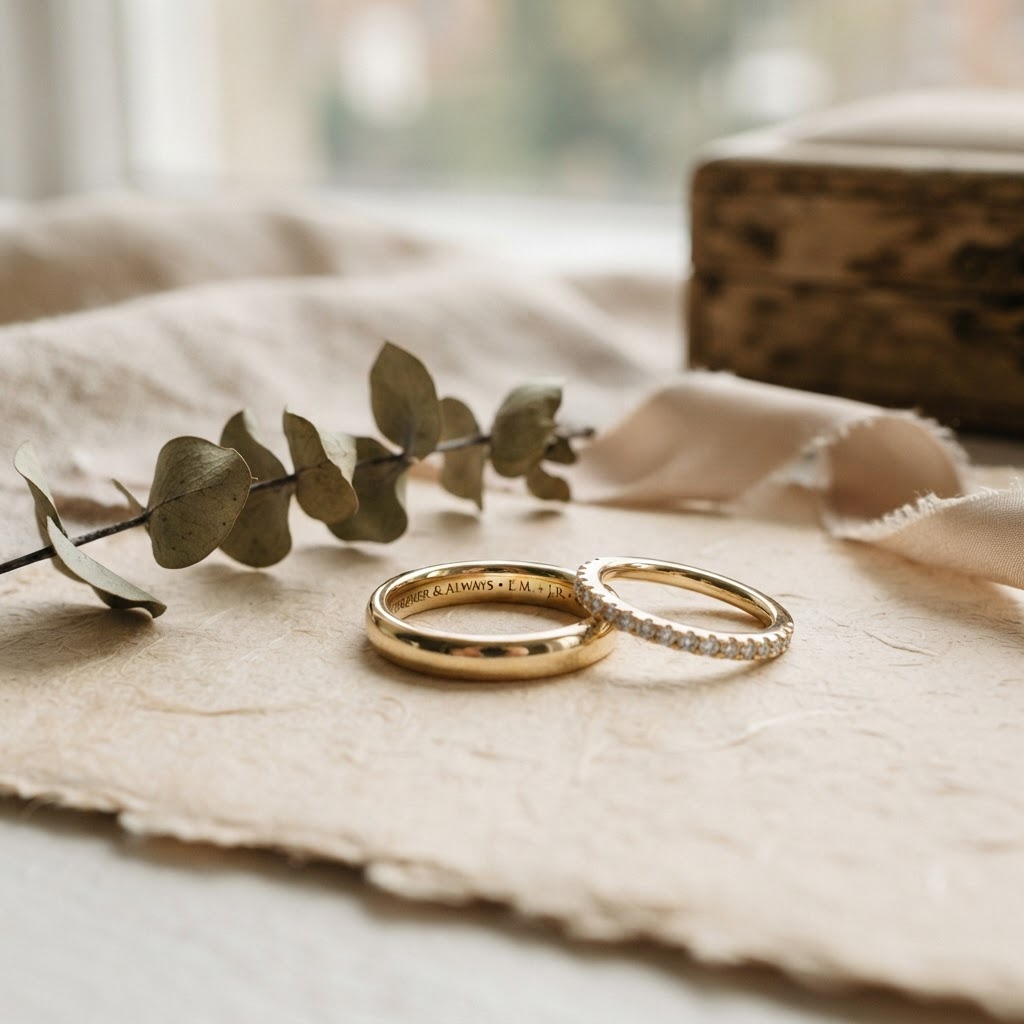
What to Engrave on a Wedding Ring: Ideas and a Practical Guide
What if the most meaningful inscription is also the simplest? Choosing what to engrave on wedding ring can feel like a small decision with lasting...
What if the most meaningful inscription is also the simplest? Choosing what to engrave on wedding ring can feel like a small decision with lasting significance. Initials, a date or a short message may all seem right, but the best choice should feel personal to you both.
Space is limited, and the ring itself affects what will fit. Band width, design and placement shape the available options, so a phrase that works on paper may need shortening. Choose wording both partners are likely to value over time.
This guide compares engraving ideas, from names and dates to shared phrases and symbols. It explains how to choose a format, account for practical limits and proofread the inscription. Use the ideas to build a shortlist, then consider how the message fits the wedding-ring design. Jewellove’s wedding rings, Ring Maker tool and bespoke design service offer ways to explore the ring as a whole.
Key Takeaways
- Compare dates, initials, brief promises and private references to find a format that reflects your relationship.
- Use “what to engrave on wedding ring” as a starting point, then shortlist wording that makes sense to both partners.
- Read each option aloud and check its meaning before settling on the final text.
- Compare inside- and outside-band placement, and consider how the ring’s dimensions and design affect space and readability.
- Plan the inscription alongside the ring design, using a considered message to guide your next design decisions.
What to engrave on a wedding ring: start with the meaning
A wedding-ring inscription is brief, personal and carried on a ring you may wear often. That can make the choice feel bigger than the number of words involved. Before drafting, decide what the inscription should represent. The question of what to engrave on a wedding ring is easier to answer when its purpose is clear.
Ring engraving is a short inscription added to a ring, commonly on the inside of the band. It might mark a date, express a promise, preserve a shared reference or record a name. These purposes aren’t interchangeable: a private reference prioritises meaning for the couple, whilst an identifier needs to be clear to someone else.
There’s a long history of short messages on rings. The history of poesy rings offers one example: these rings carried brief inscriptions over many centuries. The form is still useful as a guide. A message doesn’t need to explain everything; it needs to hold meaning for the people who chose it.
Choose the job your inscription should do
Start with one intention. Should the wording mark a date, express a promise or preserve a reference you share? Write that purpose down before you draft. It gives both partners a simple way to assess possible wording and prevents a shortlist from becoming a collection of unrelated phrases.
An inscription needn’t be elaborate to feel personal. A date can point to a milestone; a short promise can capture a shared commitment. A reference to a place or moment can carry meaning without being immediately clear to anyone else. Choose the message’s purpose first, then consider whether the wording communicates it.
Choose wording for its meaning first, then test its fit and legibility. A phrase may matter deeply, but it still needs to suit the ring and remain readable. Check practical details after you’ve agreed what the inscription should express.
Decide whether the message is shared or individual
Matching inscriptions create consistency: both rings carry the same wording. Complementary messages divide a thought between the pair, with each inscription making more sense alongside the other. Neither format is automatically more meaningful. Choose the one that reflects how you want the rings to relate.
Different wording can also be the right fit. One partner might prefer a date, whilst the other chooses a short personal phrase. Agree on the overall approach, then review each inscription together. Check the exact wording, spelling and punctuation, and make sure each partner is comfortable with what their ring will say.
Keep the first decision simple: identify the message’s purpose, decide whether it belongs on one ring or both, and draft wording that serves that purpose. Next, compare formats and refine the words themselves.
Wedding-ring engraving ideas: compare dates, initials and short messages
Once the purpose is clear, compare formats rather than trying to find one perfect phrase straight away. Dates, names, promises and private references create different kinds of reminders. Use these examples as starting points, then adapt the wording to your preferences.
Date and name formats for a wedding ring
A date can identify a wedding day or another milestone. A full version, such as “12 September 2026”, is clear at a glance but takes more space than “12.09.26”. Roman numerals offer a different look, as in “XII.IX.MMXXVI”, but can be less immediate to read. Choose a format you’ll recognise without needing to decode it.
Initials and names are separate options, not fixed companions to a date. “A + J” is compact; “Alex & Jamie” feels more explicit. Date order can be interpreted differently, so spelling out the month avoids ambiguity. The history of wedding ring engravings also shows how inscriptions have carried personal and symbolic meaning across different periods.
Short messages, symbols and private references
A short promise can express a shared commitment without becoming a long sentence. Try prompts such as “Here, always”, “Same team” or “Meet me there”. A private reference could name a meaningful place, such as “North Pier” or a favourite walking route. These work best when both partners understand the reference on its own.
Symbols can make a message more concise, but a heart, ampersand or other non-standard character may depend on the chosen engraving process. Confirm that the exact character can be reproduced before finalising the text. Don’t assume every symbol or punctuation mark will appear as typed.
Use this comparison to build a shortlist:
- Date: “12 September 2026” or “12.09.26”. Choose clarity or brevity.
- Initials or names: “A + J” or “Alex & Jamie”. Decide how much identification you want.
- Promise: “Here, always” or “Same team”. Keep the phrase easy to read.
- Place or private reference: “North Pier” or a meaningful location. Choose wording that still makes sense to both of you.
Abbreviations and punctuation can reduce a longer thought to a few words. For example, “Always by your side” might become “By your side”. Read both versions aloud. If shortening removes the part that makes the phrase yours, look for a more concise expression rather than relying on initials you may later forget.
Plan the wording alongside the ring itself. Band proportions and overall design influence how an inscription may sit, so compare the message with your wedding-ring options as you narrow the choice. If you’d like to consider the wording as part of a ring design, you can discuss your ring design with Jewellove.
How to choose wedding-ring wording that feels personal years later
A message can feel right on the wedding day and still need to make sense years later. Choose wording for its meaning, not because a particular format is popular. Initials, dates and short promises can all be useful prompts, but none is a rule. The best answer to “what to engrave on wedding ring” is wording both partners understand and are comfortable keeping.
Clear, concise wording is easier to review, proofread and reproduce accurately. Separate collecting ideas from approving the final text, so a promising phrase doesn’t move straight from a first draft to a final instruction.
Use a simple shortlist method
Start independently. Each partner writes down a few words, dates or phrases that matter to them. Compare the lists and group ideas that point to the same memory or intention. Keep phrases that stand on their own; set aside wording that needs a long explanation to make sense.
- Brainstorm: Record ideas without editing them straight away.
- Shortlist: Select the options that feel relevant to both partners, or agree which ring carries each individual choice.
- Read aloud: Say each finalist at a natural pace. Notice whether it sounds sincere, awkward or unclear.
- Check meaning: Make sure each partner understands the message in the same way.
- Confirm the text: Review spelling, punctuation, capitalisation and date order together before approving the final wording.
This sequence makes it easier to compare personal meaning with practical clarity. If a phrase only works after you explain its backstory, consider whether a simpler version could preserve the memory while making it easier to recognise later.
Check tone, language and long-term meaning
There’s no single correct tone. A sincere phrase may suit couples who prefer a direct promise; understated wording can keep the message minimal; a playful reference may reflect how you communicate. Test each against your own preferences rather than treating a popular style as a requirement. Historical accounts of rings and inscriptions, including this overview of the evolution of wedding ring inscriptions, can provide context, but your choice doesn’t need to follow tradition.
For wording in another language, verify the spelling, accents and intended meaning before settling on it. Check that the exact phrase conveys what you want, not merely what a direct translation suggests. Ask both partners to review the final version in writing, including every character and mark.
Finally, consider whether the message will matter beyond the wedding itself. A date may remain a clear marker of a shared event. A private joke can also endure, provided both partners still value it without needing the original context. Read the shortlisted wording again after a pause. If it still feels accurate and recognisable, it’s more likely to be a considered choice than a passing preference.
If you’re choosing or designing a ring at the same time, a ring design appointment gives you a chance to consider the inscription alongside the overall design.
Wedding-ring engraving practicalities: placement, length and ring design
Once the wording is shortlisted, test it against the ring. Placement, available space and legibility are connected. Inside-band text is discreet and mainly for the wearer; outside-band text is more visible and becomes part of the ring’s outward design. Neither placement suits every ring or every message. The answer to what to engrave on wedding ring also depends on how the inscription will sit on the band.
Consider placement early, not after the ring design is settled. A message intended to remain private may suit an inside surface, whilst a visible inscription needs to work with the ring’s overall appearance. The band’s width, profile and surface shape affect the area available. A narrow or curved surface may make a long phrase harder to fit and read. Technical limits depend on the ring’s dimensions and design, so avoid treating any character count as universal.
How ring shape and available space affect wording
Compare the wording with the actual band rather than judging it on a screen or page. A broad, even surface may offer more room than a narrow or shaped one, but the design still determines what can be accommodated. For couples exploring period styles, collections from Heirloom Jewelers demonstrate how vintage band profiles, intricate detailing and metalwork impact the physical space available for an inscription. Shortening a message can improve clarity on a smaller area. Keep the words that carry the meaning, and remove optional wording before reducing the text to unclear abbreviations.
Ring design and inscription planning are best considered together. Jewellove’s bespoke jewellery design service offers a way to explore how personal preferences relate to the wider ring design.
Choose a legible layout and review the details
Plain text is usually easier to scan than wording crowded with symbols or punctuation. Dates may be compact, but check that their order is clear. Capitals can distinguish initials or names, whilst excess punctuation can take up space without adding meaning. At a small scale, a layout that looks balanced in a draft may feel crowded on the ring.
- Text: Check that the full phrase remains readable.
- Punctuation: Keep only marks that clarify the message.
- Dates: Use a format both partners interpret consistently.
- Accents and symbols: Include each mark exactly as intended and check that the chosen process can reproduce it.
Before approving the inscription, review the final text as a complete layout. Check spelling, capitalisation, punctuation, accent marks and date order. Compare the version to be used with your agreed wording, character by character. Confirm the placement and layout before production, and resolve any uncertainty before giving approval.
Keep a final copy of the approved wording. It provides a clear reference during the ring-design process and reduces the chance of small changes entering the final text. If a phrase needs adjusting to suit the band, agree the revised version together before confirming it.
Plan your wedding-ring inscription with Jewellove
A shortlist turns an abstract idea into a design brief. Settle on the message, check the exact wording, then consider how it relates to the ring’s form and intended wear. This keeps the inscription connected to the ring rather than treating it as a last-minute detail.
Jewellove offers wedding rings, ring-design consultations and a bespoke design service. These are useful next steps if you’re comparing ring options or want to discuss how your inscription preference fits into a wider design. Couples in Lanarkshire and across the UK can bring a prepared shortlist to a design appointment.
Prepare a clear brief before the appointment
Keep the brief focused. Bring your preferred wording, one or two alternatives, and notes on spelling, punctuation, accents or date format. State whether you want matching messages or a different inscription on each ring. These details help organise the discussion around your priorities, without requiring you to settle every detail before considering the ring itself.
- Preferred text: Write the wording exactly as you currently intend it.
- Alternatives: Keep shorter versions in case the design calls for a more concise layout.
- Shared approach: Note whether the rings should match or carry separate messages.
- Ring preferences: Record details such as metal, band profile and how you expect to wear the ring.
Bring the list in a form you can review together. A written version makes it easier to compare the agreed text with any later edits. Mark which details are fixed, such as a name’s spelling, and which are open to discussion, such as punctuation or the choice between a full date and a shortened one.
Connect the inscription idea with the ring design
The ring’s shape and intended wear should inform the inscription decision. A phrase that suits one band may need a different layout on another. Discuss the message alongside the ring’s form, not in isolation. In a bespoke design discussion, use the selected wording and practical priorities as part of the brief, then review the final inscription carefully before approving it.
Use the appointment to compare what matters most: a particular phrase, a discreet placement, a clear date or a design preference. You don’t need to arrive with every detail settled. A clear shortlist gives the conversation a useful starting point, and any changes can be considered against the meaning you want the inscription to retain.
Before finalising, confirm the exact text and layout you’ve agreed. Check names, spelling, punctuation and date order together. Keep a copy of the approved version so both partners can refer to the same wording as the ring design takes shape.
Bring your shortlist to a design appointment and discuss your wedding-ring preferences with Jewellove.
Take your inscription idea into the design
The words you choose don’t have to be settled in isolation. Treat them as part of the ring brief: a message, preferred placement and the way you expect to wear the ring can all inform the design conversation. If you’re still weighing up what to engrave on wedding ring, bring your leading option and the question you’re trying to resolve.
Jewellove’s wedding rings and bespoke design service offer a starting point for shaping the ring around your preferences. A ring-design consultation gives you a chance to discuss how the inscription idea sits alongside the ring’s form and other design priorities. You can arrive with a clear choice or with a shortlist that still needs refining.
Use the conversation to make the design feel coherent, from the message itself to the ring that will carry it. A considered brief gives you a practical foundation for making that decision together.
Take your time, compare your options and choose wording that feels true to both of you.
Frequently Asked Questions
What is the most popular thing to engrave on a wedding ring?
Dates, initials and short messages are common wedding-ring engraving choices, but there’s no universal favourite. For anyone weighing up what to engrave on wedding ring, popularity is a prompt, not a rule. A shared date may mark a milestone; initials keep the wording compact; a short phrase can express a promise. Choose the option both partners understand and can read comfortably in the space available.
How many letters can you engrave on a wedding ring?
There’s no fixed number of letters that suits every wedding ring. Available space depends on the ring’s size, width, profile and layout, including punctuation and spaces. A phrase that fits a broad, flat band may be difficult to read on a narrower or curved design. Experienced specialists such as Robson's Jewelers often advise preparing a concise version alongside your preferred wording, then assessing both against the specific ring before settling on the text.
Can you engrave a wedding ring after the wedding?
Later engraving may be possible, but it depends on the ring’s construction, condition and the wording you want added. Wear, a shaped surface or previous changes to the band may affect suitability. A design assessment is needed to judge the individual ring, so don’t assume every band can be engraved retrospectively. Couples in Lanarkshire can include this question in a ring-design discussion before deciding on next steps.
Does engraving affect wedding-ring resizing?
Resizing can affect an inscription because the band is altered, but the result depends on the text’s position and the work required. The wording may be affected, or it may remain intact; neither outcome applies to every ring. If your size could change, consider fit and inscription placement together during design planning. This helps you account for possible future adjustments before approving the message.
Can wedding rings have different engravings?
Yes. Couples can choose identical wording, complementary messages or different inscriptions for each ring. One ring might carry a shared date whilst the other holds a personal phrase, if both partners like the arrangement. Agree whether you want a common link, such as a date or theme, then assess each inscription on its own too. Matching text is an option, not a requirement.
Can I engrave a wedding ring in another language?
Yes, wording in another language may suit a wedding ring if the text and design allow for it. Check the exact spelling, accents and intended meaning with a fluent reader, then review the written version before approval. Script and character rendering can vary, so don’t assume every writing system or mark will reproduce as expected. Keep a verified copy of the final text to compare with the version prepared for the ring.