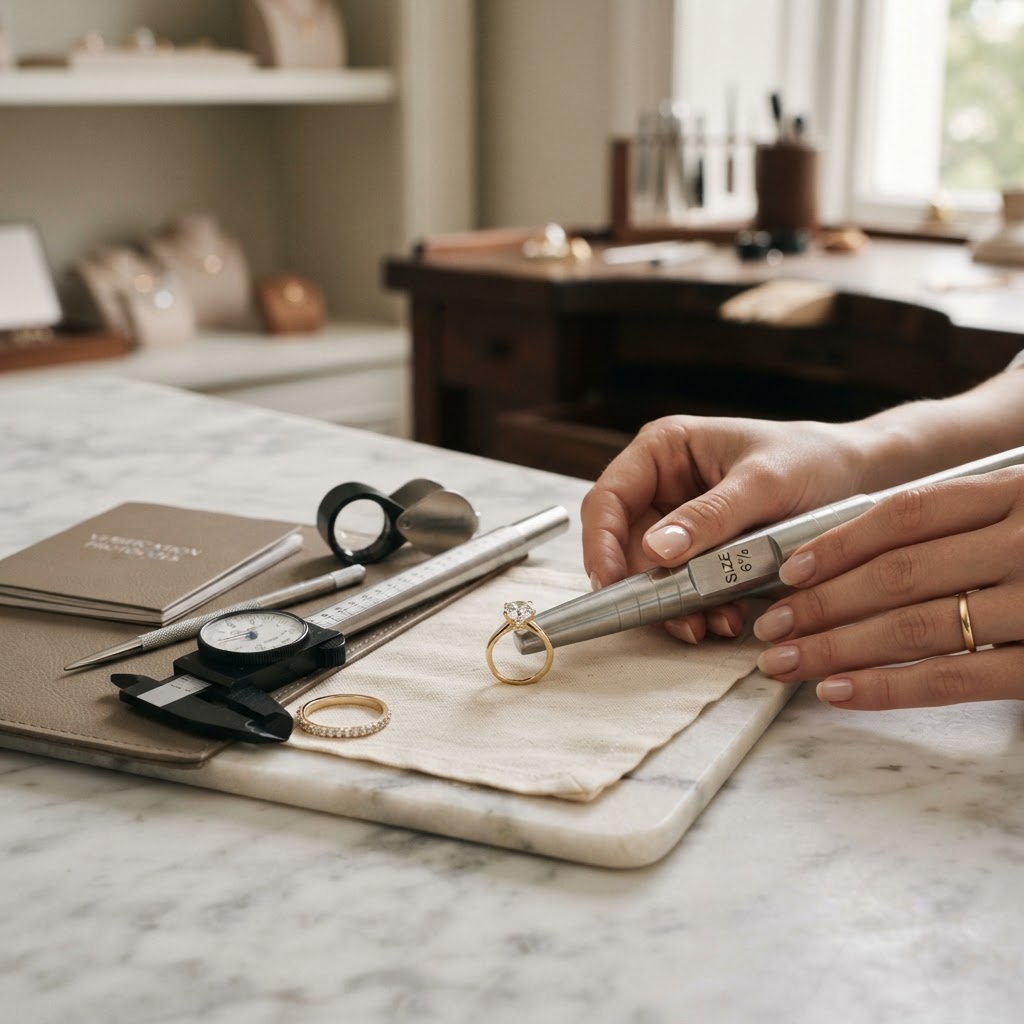
Professional Ring Sizing Kit: Technical Measurement and Verification Protocols
Did you know that natural diurnal and thermal fluctuations can alter a finger's circumference by up to 1.25mm, representing a full UK ring size shift...
Did you know that natural diurnal and thermal fluctuations can alter a finger's circumference by up to 1.25mm, representing a full UK ring size shift in a single day? This variance often leads to significant measurement errors when commissioning bespoke platinum pieces. You likely recognise that a precise fit is the foundation of structural integrity for any high-value setting. This article provides a comprehensive guide to utilising a professional ring sizing kit to ensure precise data acquisition for the Ring Maker tool. You will learn the technical mechanics of the BS EN ISO 8653:2026 standard and the specific verification protocols required for loose diamond procurement. We examine the mathematical architecture of the Wheatsheaf scale, the impact of band width compensation, and the environmental controls necessary for accurate measurement. This systematic approach eliminates the ambiguity of consumer-grade tools and provides the data points required for a secure, permanent fit.
Key Takeaways
- Identify technical differences between consumer plastic sizers and professional steel components to eliminate measurement error during data acquisition.
- Apply the UK alpha scale increments of 1.25mm per full size for precise alignment with current British manufacturing and calibration standards.
- Implement a multi-point verification schedule to mitigate the impact of diurnal fluid retention and thermal expansion on finger dimensions.
- Utilise a professional ring sizing kit to acquire the exact internal diameter coordinates required for the Ring Maker design system.
- Adjust sizing data for specific band widths and comfort-fit profiles to ensure the long-term stability of bespoke platinum and diamond settings.
Defining the Professional Ring Sizing Kit: Technical Specifications
A professional ring sizing kit is a calibrated system designed for precision data acquisition. It differs fundamentally from consumer-grade plastic strips or disposable gauges. Plastic sizers often exhibit tensile stretching and thermal flex. These variables introduce unacceptable margins of error when planning a Bespoke Design Service commission. Professional kits utilise hardened steel, stainless steel, or anodised aluminium. These materials provide high density and structural rigidity. They ensure the gauge maintains a constant internal diameter regardless of ambient temperature or applied pressure. This mechanical stability is essential for the structural integrity of platinum settings.
Anatomy of a Professional Gauge Set
Professional gauge sets consist of individual metal rings organised by size. They're typically presented on a secure wire loop or within a compartmentalised storage box for rapid comparison. Precision depends on the availability of half-size and quarter-size increments. The UK alpha scale relies on exact 1.25mm circumference steps between full sizes. A high-specification kit includes these subdivisions to ensure a secure fit for heavy loose diamonds. Width specifications are equally critical. Standard kits often provide two distinct sets of gauges:
- Narrow Gauges: Typically 2.5mm to 3mm in width for solitaire configurations.
- Wide Gauges: 5mm to 7mm widths to account for increased skin displacement and friction.
Material density affects the perceived fit. Heavy metal gauges mimic the "drag" and inertia of a final platinum band. This allows the user to feel how the ring responds to movement, which plastic alternatives cannot replicate.
The Function of the Ring Mandrel
The ring mandrel, or triblet, serves as the secondary verification tool in a professional ring sizing kit. It's a tapered metal rod used to cross-reference physical gauges or existing jewellery. Technical accuracy requires a calibrated mandrel. Under the BS EN ISO 8653:2026 standard, professional mandrels feature a graduated scale length of 160.0mm. This ensures the tool matches the internal diameter of the corresponding gauge rings.
Data verification requires specific measurement protocols. For narrow rings under 3mm, jewellers measure to the leading edge where the band contacts the mandrel. For wider bands exceeding 5mm, the measurement is taken from the centre line of the ring. This distinction prevents half-size discrepancies during production. The resulting data points are then entered into the Ring Maker tool to define the final manufacturing coordinates. Utilising these professional standards eliminates the guesswork associated with uncalibrated tools.
UK Sizing Standards: The A-Z Alpha Scale Analysis
The UK alphabetical sizing system, technically known as the Wheatsheaf scale, provides the mathematical framework for British jewellery manufacturing. This system categorises finger dimensions using letters A through Z, with additional increments extending to Z+6. Unlike international numeric scales, the UK system relies on specific millimetre intervals that ensure consistency across different workshops. Utilising a professional ring sizing kit calibrated to these standards is essential for capturing the precise data required for a Bespoke Design Service. Accuracy at this stage prevents structural failures in high-value platinum settings.
The UK Alpha Scale Explained
The architecture of the UK scale is codified under BS 6820. Each full alphabetical increment represents exactly 1.25mm of internal circumference. This measurement translates to an internal diameter increase of approximately 0.398mm per full size. Half-sizes represent a 0.625mm circumference shift. Size C serves as the baseline anchor at 40.0mm circumference, whilst Size A corresponds to 37.5mm. Statistical data indicates that the average UK size for women's rings is L to M. Men's rings typically average at size T. Precision depends on where the ring contacts the measuring tool. Narrow bands are verified at the leading edge, but wider bands require a centre-line reading to account for increased surface contact.
International Data Conversion
Bespoke procurement often involves converting international data for UK production. US numeric sizes and EU millimetre scales don't align perfectly with the UK alpha system. A US size 7, for example, is approximately a UK size O, but the millimetre coordinates may vary by up to 0.1mm. EU sizing typically uses the direct internal circumference (e.g., EU 54). Relying on nominal labels during conversion often introduces cumulative errors. A professional ring sizing kit allows for the acquisition of raw internal diameter (ID) coordinates. These coordinates are more reliable than letter or number labels when entering specifications into the Ring Maker tool. Mapping these values directly to the UK scale ensures the final piece maintains its intended fit. You can organise your sizing data through our digital interface to begin the technical design flow. If you require further assistance with complex conversions, you might book an appointment to speak with a technical consultant.
Measurement Protocols: Environmental and Biological Variables
Precise data acquisition requires more than a single measurement event. Biological and environmental variables cause the human digit to fluctuate in volume throughout a standard 24-hour cycle. A professional ring sizing kit provides the tools for systematic verification, but the user must apply a rigorous protocol to account for these shifts. Failure to recognise these variables often results in a fit that's either restrictive or prone to rotation. This compromises the wearer's experience and the security of the Ring Maker specifications. Methodical tracking is the only way to ensure long-term structural integrity.
Thermal and Circadian Fluctuations
Finger dimensions are not static. Research indicates that diurnal fluid retention and ambient temperature shifts cause digits to fluctuate by 0.5 to 1.0 full UK ring size. This represents a variation of 0.625mm to 1.25mm in circumference. To mitigate this error, record measurements at three distinct intervals: morning, mid-afternoon, and evening. Capture a baseline snapshot when the subject is at resting core temperature. Optimal conditions occur in a room between 19°C and 22°C. Avoid measurement immediately following strenuous exercise, high-sodium meals, or long-duration flights. These activities induce temporary swelling that doesn't reflect the finger's stable state. Consistency across these snapshots allows for the calculation of a reliable data average for your Bespoke Design Service project.
The Mechanics of the Knuckle
The knuckle-to-base ratio determines the ease of application and the security of the final piece. A ring must pass over the interphalangeal joint with slight resistance, often described as a "click" or "pop" sensation. If the gauge slides over the knuckle with zero friction, the ring will likely spin at the base of the finger. This is particularly problematic for top-heavy solitaire configurations. For clients with prominent joints and slender proximal phalanxes, standard sizing often proves insufficient. Technical protocols suggest measuring both the knuckle and the base to identify the differential. In cases where the joint is significantly larger than the base, consider technical modifications such as dual sizing beads. These small spheres, typically soldered at the 4 and 8 o'clock positions, provide the necessary grip whilst allowing the band to pass over the joint. Utilising a professional ring sizing kit with both narrow and wide gauges allows for the testing of these mechanical interactions before production begins.
Selecting a Kit for High-Value Bespoke Procurement
Selecting a professional ring sizing kit requires an understanding of tool calibration and material stability. For platinum and diamond ring planning, the kit must offer zero-tolerance repeatability. Industry standards for 2026, specifically BS EN ISO 8653:2026, dictate that mandrels and gauge rings must match within a 0.02mm tolerance. Cheap, uncalibrated kits often deviate by up to half a UK size; a discrepancy that compromises the final setting. You can verify a low-cost kit by measuring the internal diameter of the gauges with digital vernier calipers. If the measurements don't align with the 1.25mm circumference increment standard, the data is unsuitable for high-value procurement. Precise sizing data serves as the primary input for the Jewellove Ring Maker interface, where exact coordinates define the manufacturing path.
Band Width and Profile Considerations
Band width significantly alters the perceived fit on the finger. A 2mm band has less surface contact and friction than a 6mm band. For every millimetre of width above 4mm, you must account for increased skin displacement. Rings wider than 5mm typically require a +0.5 to +1.0 full UK size allowance compared to narrow gauges. Your chosen sizer must mirror your intended bespoke design profile. Standard-fit gauges feature a flat internal surface, whilst comfort-fit profiles are domed. Domed interiors concentrate pressure at the centre of the band. They often fit looser than flat profiles of the same nominal diameter. Accurate data adjustment for these profiles prevents the need for invasive resizing after production. This is especially critical for platinum, which incurs a 1.5% to 2.0% volumetric shrinkage factor during the casting process.
Local Acquisition in Lanarkshire
Lanarkshire-based design protocols prioritise local data verification to ensure accuracy before the bench work begins. Sourcing a professional measurement tool locally allows you to perform the multi-point verification schedule previously discussed. This local acquisition stage integrates directly with online diamond procurement workflows. By capturing exact millimetre coordinates at home, you provide the technical foundation for the CAD-driven manufacturing process. Professional kits used in Lanarkshire ateliers typically feature hardened steel mandrels with a 64 RC rating to prevent surface wear. Once you've gathered these snapshots, you can cross-reference the data with a technical consultant to finalise the specifications for your setting.
Data Integration: From Measurement to Ring Production
Data integration is the final phase of the technical measurement protocol. After utilising a professional ring sizing kit to capture multi-point snapshots, you must organise this information for digital entry. The Jewellove management system requires precise alphabetical coordinates to initiate the manufacturing workflow. This systematic approach ensures that the physical dimensions of the digit align perfectly with the CAD parameters of the final piece. Organising data into a centralised profile allows for the tracking of fluctuations over time. It provides a reliable reference point for future commissions within a Bespoke Design Service framework. Direct integration of these data points minimises the risk of manual transcription errors during the production cycle.
Using the Jewellove Ring Maker
The Ring Maker tool functions as the primary interface for custom specification entry. Users must input the verified alphabetical size, including half-size or quarter-size increments where applicable. This step is critical when selecting metal types such as Platinum 950. Platinum requires specific volume calculations due to its high density and 1.5% to 2.0% casting shrinkage. The tool automatically adjusts the internal bore coordinates based on the selected size and band profile. Saving these sizing snapshots to a permanent jewellery profile facilitates long-term data management. This digital record eliminates the need for repeated physical measurements during subsequent procurement cycles. It ensures consistency across different product categories, from wedding bands to engagement rings.
Post-Acquisition Maintenance
Effective jewellery care begins with consistent fit monitoring. Platinum is a highly durable material, but its structural integrity depends on a secure initial fit. Resizing protocols vary significantly by setting type. Solitaire rings allow for standard adjustments, whilst full eternity rings have significant resizing limitations due to the continuous loose diamonds channel. Invasive resizing can compromise the tension of the stones or the circularity of the band. Tracking long-term data for wedding and eternity ring sets is essential. These pieces often feature wider bands that require precise sizing snapshots to maintain comfort across decades of wear. Systematic monitoring of the fit ensures that any biological shifts are identified before they pose a risk to the security of the setting. Maintain your professional ring sizing kit for annual verification to ensure your data remains current and accurate. Regular audits of your sizing profile prevent the loss of high-value assets due to an improper fit.
Optimising Technical Data for Bespoke Production
Accurate measurement is the fundamental first stage in the technical design flow. A professional ring sizing kit provides the calibrated baseline required to eliminate manufacturing errors and ensure structural integrity. You've identified how biological fluctuations and thermal shifts necessitate a multi-point verification schedule to capture a reliable data average. You also understand the importance of aligning data with the BS EN ISO 8653:2026 standard for high-value diamond rings. As a specialist in Lanarkshire bespoke design protocols, Jewellove provides precision measurement support to ensure every platinum setting maintains its long-term stability. The transition from raw millimetre coordinates to a finished piece requires absolute transparency and logical tracking. By following the Wheatsheaf baseline and accounting for band width compensation, you remove the ambiguity of consumer-grade tools. This systematic approach empowers you to manage your jewellery profile with tech-enabled confidence.
Apply these systematic protocols to secure your data today. Precise measurement ensures a permanent, secure, and comfortable fit for your bespoke commission.
Frequently Asked Questions
What is the most accurate time of day to use a professional ring sizing kit?
Mid-to-late afternoon is the most accurate time for measurement. Fingers typically reach their peak volume during this interval due to daily fluid retention and core temperature stability. Morning measurements often yield an undersized result, leading to a restrictive fit. Capture three snapshots over a 24-hour cycle to establish a data average for your Lanarkshire project. This systematic approach ensures the Ring Maker tool receives precise input coordinates.
How much resistance should a ring have when passing over the knuckle?
A ring should require slight physical resistance to pass over the interphalangeal joint. This is often characterised by a distinct "pop" sensation upon application. If the gauge slides over the joint without friction, the piece will likely rotate at the base. This mechanical interaction is essential for the security of top-heavy solitaire settings. Use a professional ring sizing kit to test this resistance across multiple days.
Can I use a professional sizer to measure for a surprise engagement ring?
Measurement for a surprise commission requires cross-referencing an existing ring on a calibrated mandrel. Place a ring the recipient currently wears on the fourth finger of the left hand onto the triblet. Note the exact point where the band contacts the metal. Verify if the measurement is taken at the leading edge or centre line. This protocol provides the technical coordinates for Lanarkshire-based production without requiring the recipient's direct involvement.
What is the difference between a wide-band sizer and a standard sizer?
Wide-band sizers measure 5mm to 7mm in width, whilst standard sizers typically measure 2.5mm to 3mm. Wider bands displace more skin and create higher contact friction. This displacement usually necessitates a size increase of +0.5 to +1.0 full UK size. Selecting the sizer that mirrors the intended bespoke design prevents sizing discrepancies during the production of wedding or eternity rings in the Lanarkshire workshop.
How do UK ring sizes correspond to millimetre measurements?
The UK alpha scale follows the Wheatsheaf standard where each full letter represents exactly 1.25mm of internal circumference. This equates to an internal diameter increment of approximately 0.4mm per full size. Size C corresponds to 40.0mm circumference, whilst Size A is 37.5mm. Professional Lanarkshire design protocols rely on these precise millimetre coordinates rather than approximate estimates to ensure structural integrity in platinum settings.
Why should I avoid using paper sizers for expensive diamond rings?
Paper and plastic strip sizers lack the material density and structural rigidity required for high-value procurement. These materials are prone to stretching, tearing, and thermal expansion, which introduces significant data error. A professional ring sizing kit made of hardened steel provides a constant internal diameter. This stability is critical when commissioning a Bespoke Design Service piece involving heavy loose diamonds for a Lanarkshire client.
Is it possible to resize a platinum bespoke ring after production?
Platinum resizing is possible but depends heavily on the setting configuration. Solitaire rings allow for standard adjustments, but full eternity rings or channel-set designs have severe resizing limitations. Invasive resizing can destabilise stone tension or alter the circularity of the band. Establishing an accurate sizing snapshot before production is the most efficient method to maintain the integrity of a bespoke Lanarkshire commission.
How does temperature affect the accuracy of my sizing data?
Ambient temperature shifts cause biological tissue to expand or contract. Cold conditions induce vasoconstriction, resulting in a smaller finger diameter. Warm environments cause vasodilation and increased digit volume. Technical protocols in Lanarkshire require sizing to occur at resting core temperature within a range of 19°C to 22°C. Accurate data acquisition depends on maintaining these environmental controls to prevent a seasonally biased fit.