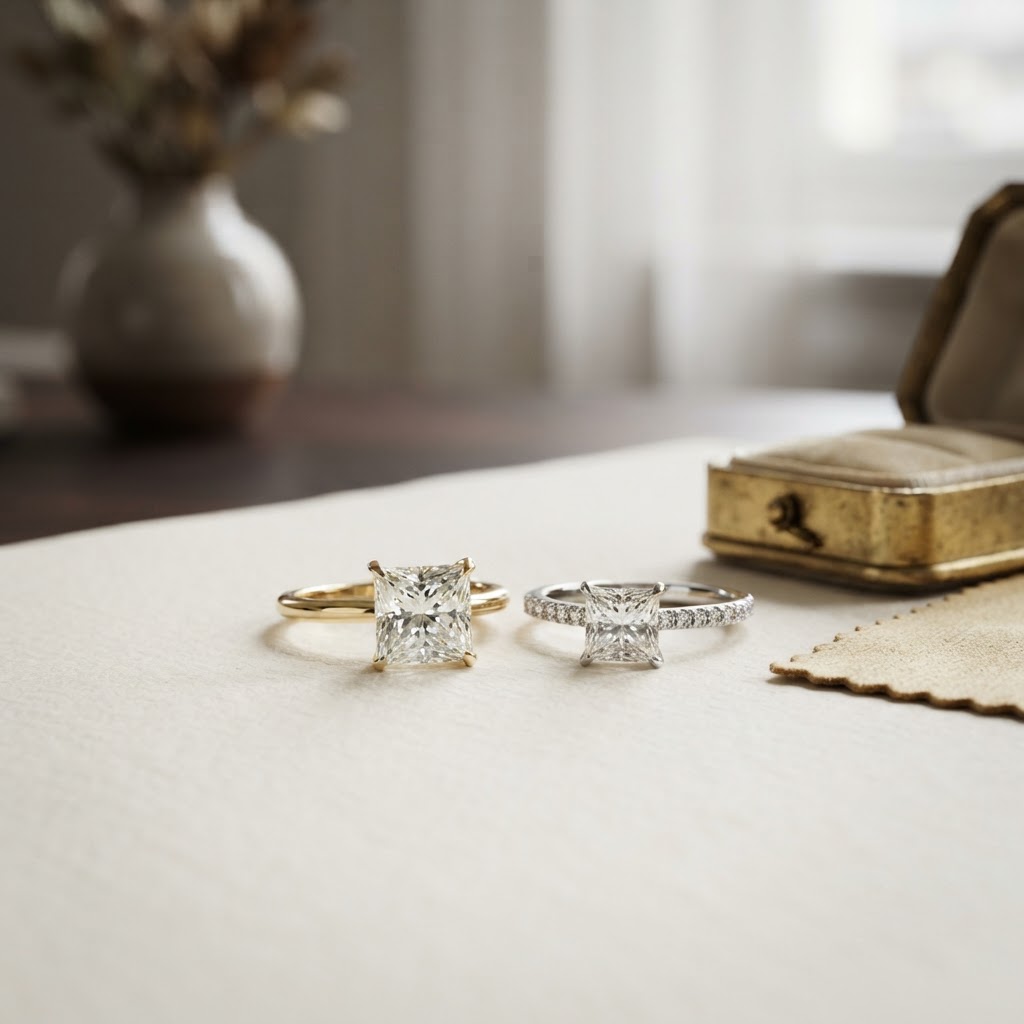
Princess Cut Diamond Ring UK: Technical Comparison and Procurement Guide
A well-cut princess diamond returns approximately 70% of the light that enters its surface, yet it offers superior carat-weight efficiency compared...
A well-cut princess diamond returns approximately 70% of the light that enters its surface, yet it offers superior carat-weight efficiency compared to round geometries. Selecting a princess cut diamond ring UK buyers often find technically complex requires a transition from aesthetic observation to systematic data analysis. You likely recognise that retail markups and inconsistent grading terms frequently obscure the objective value of a gemstone. This guide provides a clinical evaluation of princess cut geometries, reflective performance metrics, and established procurement protocols for the UK market.
We will examine why the GIA does not currently assign an overall cut grade to this shape and how to evaluate light return through pavilion chevron counts. This analysis includes essential data on UK VAT rates, 2026 hallmarking requirements, and the logistics of loose diamond procurement. You will acquire a structured framework for using digital tools to organise and compare diamond specifications. The following sections categorise technical data points to facilitate a logical and efficient decision-making process. This approach ensures that the selection of a loose diamond remains an objective exercise in data management and process optimisation.
Key Takeaways
- Define the square modified brilliant geometry and the inverted pyramid structure that distinguishes it from step-cut varieties.
- Evaluate the "crushed ice" scintillation of a princess cut against the "hall of mirrors" effect found in emerald geometries.
- Implement protective setting protocols, specifically V-prongs, to mitigate the structural vulnerability of the four 90-degree corners.
- Apply "under-size" procurement logistics to optimise the visual dimensions of a princess cut diamond ring UK relative to carat weight.
- Utilise the Ring Maker tool to facilitate a data-driven customisation process for loose diamond selection and ring design.
Geometric Analysis: Defining the Princess Cut Standard
The princess cut is categorised as a square modified brilliant geometry. It's defined by an inverted pyramid structure that tapers to a single point. This configuration distinguishes it from step-cut geometries, such as emerald or Asscher cuts, which utilise parallel rectangular facets. The brilliance of the princess cut stems from its chevron facet pattern located on the pavilion. These facets break up light into smaller, more frequent flashes. This specific arrangement adheres to the Princess Cut Standard, which prioritises light return over the linear clarity found in older square shapes. Development of this cut occurred in the late 1960s and 1970s. It was designed as a modern, efficient alternative to the round brilliant cut.
Anatomy of a Square Modified Brilliant
The technical structure of the princess cut involves a large, flat table and a crown with varying facet counts. The pavilion usually contains two, three, or four chevron patterns. Each additional chevron layer increases the scintillation but decreases the size of the light flashes. The girdle serves as the perimeter of the stone. It's a critical component for maintaining structural integrity, especially at the four 90-degree corners. One primary advantage of this geometry is its yield. Cutting a princess diamond retains approximately 60% to 80% of the original rough crystal. Round brilliant cuts are less efficient, often discarding over half of the rough material. This logistical efficiency is a primary driver for the competitive pricing of a princess cut diamond ring UK consumers find in the current market.
The UK Market Context for Square Geometries
In the UK, the princess cut remains a primary choice for bespoke engagement rings. Buyers often compare options between traditional London showrooms and digital procurement platforms based in Lanarkshire. The shift toward direct-to-consumer models allows for better tracking of technical specifications. Regulatory standards for diamond grading in the British market typically involve GIA or IGI certifications. These reports provide snapshots of polish and symmetry. Because the GIA does not assign a definitive cut grade to fancy shapes yet, buyers must rely on depth and table percentages to organise their search. Using the Ring Maker tool facilitates this comparison by filtering loose diamonds based on these specific geometric ratios. This systematic approach ensures that the selected diamond meets the required performance metrics without the overhead costs associated with high street retail environments.
Performance Comparison: Princess vs. Emerald and Round Cuts
Comparing light return across geometries requires a standardised metric. Round brilliant diamonds remain the industry benchmark for fire, returning over 90% of light. A princess cut diamond ring UK buyers evaluate typically achieves approximately 70% light return. Emerald cuts, which are step-cuts, prioritise clarity over brilliance. They produce a "hall of mirrors" effect through parallel facets. In contrast, the princess cut creates a "crushed ice" scintillation pattern. This effect results from the high density of small facets on the pavilion. It provides a more modern aesthetic whilst maintaining a level of brilliance that step-cuts cannot match.
Visual footprint varies significantly by shape. A 1.00ct round brilliant has a diameter of approximately 6.4mm. A 1.00ct princess cut measures roughly 5.5mm across the sides. However, the diagonal measurement of a princess cut often exceeds the diameter of a round stone of equal weight. This creates a different visual impact depending on the viewing angle. Buyers must decide between the concentrated fire of a round cut and the geometric efficiency of a square shape. Round cuts offer the highest reflective index, but princess cuts provide a sharper, more structured appearance.
Reflective Index and Scintillation Protocols
Light enters the table of a princess cut and reflects off the pavilion chevrons. The number of chevrons determines the size and frequency of the light flashes. Two chevrons produce larger flashes. Four chevrons create a rapid, "crushed ice" scintillation. This effect is highly effective at obscuring internal inclusions. Emerald cuts do not share this capability. Their large, open facets make inclusions easily visible to the naked eye. Consequently, princess cuts allow for lower clarity grades whilst maintaining an eye-clean appearance. This technical trait allows for significant cost savings without compromising the visual integrity of the stone.
Geometric Value Efficiency
Rough diamond crystals are naturally octahedral. Princess cuts utilise this shape with minimal waste. This high yield reduces the cost per carat for the end user. When comparing Jewellove Diamonds data, princess cuts often provide a 20% to 30% price advantage over round stones of identical 4C parameters. This efficiency makes the princess cut diamond ring UK market a logical sector for those prioritising carat weight amongst other variables. To discuss specific technical configurations for a bespoke project, you may arrange a technical consultation.
Structural Integrity: Setting Protocols for Square Geometries
The four 90-degree corners are the primary points of mechanical vulnerability. Unlike round geometries, these points are prone to chipping if subjected to impact. Secure housing is mandatory for any princess cut diamond ring UK buyers intend for daily wear. Setting height also influences safety. High-profile settings increase exposure to accidental contact. Low-profile or flush settings provide superior protection but may restrict light entry through the pavilion facets. A balanced setting height ensures the diamond remains secure whilst allowing sufficient light to interact with the chevron facet patterns described in previous sections.
The Role of V-Prongs in Diamond Protection
V-prongs, or V-shaped claws, provide a mechanical wrap around the corners. This design distributes pressure across the edge rather than a single point. Standard round prongs leave the tip of the corner exposed. V-prongs mitigate this risk effectively. Visually, these prongs maintain the sharp square silhouette of the stone. A four-prong configuration is the standard for square geometries. It provides a snapshot of the stone's full surface area without excessive metal coverage. Six-prong setups are rare for princess cuts as they can interfere with geometric symmetry and increase the visual footprint of the metal housing.
Metal Choice and Maintenance Data
Metal durability determines the long-term security of the setting. Platinum is a naturally white, dense metal that doesn't wear away over time. It develops a patina but retains its volume. 18ct white gold requires periodic rhodium plating to maintain its colour. This adds a recurring maintenance cost to the ownership lifecycle. Platinum is the preferred choice for bespoke settings due to its superior grip on the diamond. It is less likely to deform under stress compared to gold alloys, ensuring the stone remains locked in position.
UK hallmarking regulations are strict. Any platinum item over 0.5 grams must be hallmarked at a UK assay office. This ensures the purity of the metal housing. The official date letter for 2026 is "B". Buyers should review established Jewellery Care protocols to monitor prong tension. Regular snapshots of the setting condition help identify loose stones before loss occurs. Process optimisation in procurement includes selecting a metal that balances initial cost with long-term maintenance requirements.
Procurement Logistics: Carat Weight and Visual Dimensions
Procuring a princess cut diamond ring UK requires a data-driven approach to carat weight versus millimetre dimensions. Carat is a unit of mass, not a direct measurement of surface area. A diamond with excessive depth may weigh 1.00ct but present the visual footprint of a 0.85ct stone. This "hidden weight" represents a logistical inefficiency. Systematic buyers prioritise the length-to-width ratio, which should not exceed 1.05 to 1 for a square appearance. Targeting "under-size" procurement, such as selecting a 0.90ct stone instead of a 1.00ct stone, allows for budget optimisation. These stones are virtually indistinguishable to the naked eye but lack the market premium of whole-number weights.
The "Magic Weights" and Budget Optimisation
Diamond pricing is non-linear. Market data shows significant price jumps at 0.50ct, 0.75ct, and 1.00ct thresholds. These are often referred to as "magic weights" in the trade. A 0.88ct stone typically offers a superior value-to-size ratio compared to a 1.00ct stone. Buyers should prioritise Cut performance over Carat weight to maximise light return. High-quality cut parameters ensure the stone achieves the 70% reflective index discussed in previous sections. Use loose diamond databases to track specific snapshots of available inventory. This process allows for the comparison of depth percentages and table widths across multiple stones simultaneously.
Metal Price Snapshots for Accurate Budgeting
The complete procurement process includes the selection of precious metal housing. Metal price snapshots are essential for accurate budgeting. Platinum and 18ct gold rates are influenced by daily market fluctuations. The direct-to-consumer model utilised by Lanarkshire-based platforms eliminates the 20% to 50% markups found in high street showrooms. Logistics for UK buyers are managed through local distribution centres, ensuring secure transit and adherence to British hallmarking requirements. Bespoke production timelines generally span three to five weeks, including the mandatory assay office certification. This structured timeline allows for precise project management from the initial design snapshot to final delivery.
Customisation Interface: Designing a Princess Cut Ring
The Jewellove Ring Maker interface functions as a digital facilitator for bespoke assembly. It allows users to organise technical data into a cohesive design snapshot. This platform categorises setting styles into three primary configurations: Solitaire, Halo, and Three-Stone. Solitaire settings emphasise the square modified brilliant geometry without visual distraction. Halo configurations incorporate a perimeter of brilliant-cut stones to increase total light return. Three-stone designs utilise geometric flanking to create a balanced silhouette. Designing a princess cut diamond ring UK consumers can manage effectively requires a transition from this digital environment to a Custom Design Consultation for final engineering verification.
Systematic Design Workflow
Follow this protocol to ensure design consistency and structural integrity. First, filter the loose diamonds database using the parameters established in previous sections, specifically depth and table percentages. Second, select a metal type that aligns with long-term durability requirements. Platinum is the recommended standard for secure corner housing. Third, review the design comparison data. The interface provides a snapshot of the visual footprint relative to the carat weight. This workflow eliminates the ambiguity often associated with high street retail experiences. It empowers the user to track every specification before committing to the procurement phase.
Final Verification and Heritage
Every bespoke order undergoes a final verification process. This includes the validation of GIA or IGI certifications to ensure the stone matches the reported technical snapshots. The Jewellove Heritage is defined by this commitment to data transparency and clinical precision. UK buyers should complete a final checklist before procurement is finalised:
- Confirm the presence of a GIA or IGI grading report for the central stone.
- Verify that the setting utilises V-prongs for corner protection.
- Ensure the metal housing meets UK hallmarking requirements for platinum or gold.
- Review the 20% VAT inclusion and delivery logistics from the Lanarkshire centre.
This systematic approach ensures the final product meets the high standards of British jewellery manufacturing. It transforms a complex procurement task into a manageable and logical workflow. By adhering to these protocols, you ensure that the technical performance of the diamond is preserved within a secure and durable setting.
Optimising Your Princess Cut Procurement
The procurement of a princess cut diamond ring UK requires a systematic evaluation of geometric yield and reflective performance. You've identified the technical advantages of the square modified brilliant shape and the mechanical necessity of V-prong settings. This data-driven approach eliminates the inefficiencies often found in high street retail environments. Our direct-to-consumer model facilitates the removal of middleman markups and prioritises transparency throughout the lifecycle of the order. We provide comprehensive metal price tracking tools to ensure budget accuracy during the initial design phase. Lanarkshire-based expert design consultations offer a professional verification stage for every bespoke project. Use the available digital interfaces to organise your specifications and track your procurement progress with clinical precision.
This logical workflow ensures the final product meets your established durability and aesthetic requirements. You now possess the technical framework necessary to manage the selection of a loose diamond and the engineering of a secure setting. Proceed with confidence in your data.
Frequently Asked Questions
Are princess cut diamonds more expensive than round diamonds in the UK?
Princess cut diamonds are typically more cost-effective than round brilliant diamonds. The cutting process retains more of the original rough crystal, often between 60% and 80%. This efficiency results in a lower price per carat. Buyers in Lanarkshire can use our direct-to-consumer model to avoid high street markups. This approach ensures the procurement of a princess cut diamond ring UK remains within a logical budget compared to round alternatives.
Do princess cut diamonds look smaller than other shapes of the same carat weight?
Princess cut diamonds possess a smaller surface area than round diamonds of equal carat weight. A 1.00ct round diamond measures approximately 6.4mm whilst a 1.00ct princess cut measures roughly 5.5mm across its sides. However, the diagonal measurement of a square stone often exceeds the diameter of a round stone. Use the Ring Maker tool to compare visual footprints. This data-driven comparison helps you organise your selection based on millimetre dimensions.
What is the best setting for a princess cut diamond ring to ensure safety?
V-prong settings provide the highest level of safety for square geometries. These settings wrap around the four 90-degree corners to distribute pressure and prevent chipping. Standard round prongs leave the vulnerable tips exposed to impact. Our Lanarkshire-based design team recommends V-shaped claws for all bespoke princess cut configurations. This setting protocol maintains the sharp silhouette of the stone whilst ensuring the structural integrity of the housing remains intact over time.
Can I use a princess cut diamond in a bespoke platinum ring design?
You can incorporate a princess cut diamond into a bespoke platinum ring design through our digital platform. Platinum is a dense, durable metal that provides superior grip for square diamonds. It doesn't wear away like gold alloys. Every platinum setting produced for our Lanarkshire clients adheres to strict UK hallmarking requirements. You can track metal price snapshots to budget for your bespoke platinum housing with precision before the design phase begins.
How does the reflective performance of a princess cut compare to an emerald cut?
Princess cuts offer significantly higher brilliance than emerald cuts. The princess cut is a modified brilliant geometry with a "crushed ice" scintillation pattern. It returns approximately 70% of light. Emerald cuts are step-cuts that prioritise linear clarity over light return, resulting in a "hall of mirrors" effect. If you prioritise sparkle, the princess cut is the efficient choice. Emerald cuts are better suited for buyers prioritising the internal transparency of the stone.
What are the most important 4Cs to prioritise for a princess cut diamond?
Prioritise Cut and Clarity when evaluating princess cut specifications. Cut quality determines the reflective index and scintillation frequency. Clarity is essential because the four corners are prone to showing inclusions if they aren't eye-clean. Colour is often a secondary priority as you can frequently select an H or I colour grade without a perceptible loss in visual quality. Use the 4Cs guide within our digital tools to categorise and compare available inventory.
Is a 1-carat princess cut diamond ring suitable for a budget-conscious buyer?
A 1-carat princess cut diamond ring is an achievable goal for budget-conscious buyers using a systematic procurement strategy. Target "under-size" stones, such as 0.90ct, which offer the visual footprint of a 1.00ct stone without the market premium. Our direct-to-consumer model in Lanarkshire eliminates retail overheads. This process optimisation allows you to allocate more budget to cut quality. Review the metal price snapshots to track the total project cost accurately.
How do I maintain the brilliance of my princess cut diamond ring at home?
Maintain brilliance by cleaning the stone with warm water and mild detergent. Use a soft-bristled brush to remove debris from the pavilion facets. Avoid harsh chemicals that can affect the metal housing. We provide detailed care protocols through our digital resources. Lanarkshire clients should also schedule regular professional snapshots of the setting. This ensures the V-prongs remain tight and the corners of the diamond stay protected from mechanical stress during daily wear.