Solitaire Diamond Rings UK: A Technical Procurement Reference
A 1.00-carat lab-grown diamond currently costs approximately 93.35% less than a natural stone of equivalent grade. High-street retail markups and...
A 1.00-carat lab-grown diamond currently costs approximately 93.35% less than a natural stone of equivalent grade. High-street retail markups and opaque grading standards often obscure the functional value of jewellery. Acquiring a high-specification solitaire diamond ring UK requires a shift from traditional retail browsing to systematic procurement. You likely recognise that inconsistent grading and confusion over metal maintenance make the acquisition process unnecessarily complex.
This reference guide provides a technical framework for evaluating stone quality, metal durability, and configuration logistics. We will examine the data-driven process of selecting loose diamonds, the structural superiority of bespoke platinum settings, and the legal requirements for UK hallmarking. Every decision point is mapped to objective data, from the 0.5-gram hallmarking threshold for platinum to the 20% VAT implications on final procurement. Use this guide to organise your search and secure a precision-engineered asset.
Key Takeaways
- Identify why technical Cut grading is the primary variable in determining light performance and visual output.
- Evaluate the maintenance requirements and structural durability of platinum versus gold alloys for long-term asset protection.
- Execute a "loose diamond first" procurement strategy to secure a high-specification solitaire diamond ring UK without high-street retail markups.
- Utilise the Ring Maker interface to configure technical specifications and bridge the gap between data and physical design.
- Transition from data-driven selection to physical acquisition through the Lanarkshire-based bespoke implementation protocol.
Defining the Solitaire Diamond Ring: Structural and Aesthetic Parameters
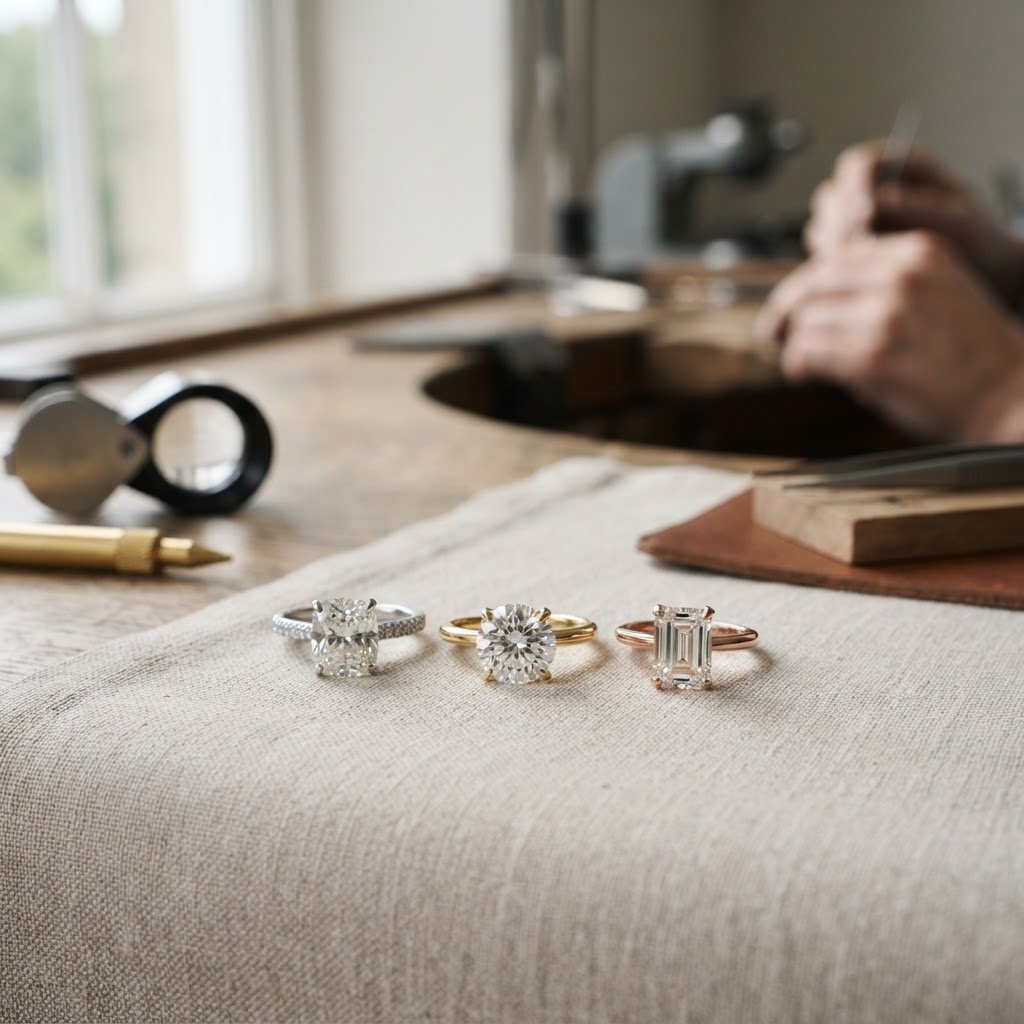
A solitaire diamond ring UK is defined by a single, central gemstone mounted on a metal band. This configuration eliminates competing visual elements. It prioritises the technical performance of the primary asset. Historically, the history of engagement rings shows the solitaire as the standard for clarity and simplicity. It remains the most popular choice for engagement jewellery in the United Kingdom due to its efficient design. High-performance solitaires are identified by precise symmetry and optimal light return rather than decorative complexity. The design logic focuses on the stone's inherent properties. It's a system built to showcase a single data point of high value.
Objective criteria for a high-performance solitaire include stone-to-band proportions and setting height. A well-engineered ring balances the carat weight with the shank width. This ensures the stone remains the focal point without compromising structural stability. In the UK market, the solitaire is the benchmark for assessing diamond quality. It offers no concealment for inclusions or poor cut grades. This transparency makes it the preferred choice for those prioritising verified technical specifications.
The Utility of the Single-Stone Configuration
The single-stone configuration maximises light entry through the crown and return through the table. Multi-stone settings often introduce metal interference. This interference reduces the reflective index of the primary stone. A solitaire allows for 360-degree light exposure. This exposure ensures the diamond's internal fire and brilliance are fully utilised. It's the most efficient method for displaying high-grade stones. High-performance diamonds require this unobstructed path to achieve maximum scintillation. Clustering stones often masks lower-grade facets, whereas the solitaire highlights every technical detail.
Core Components of the Solitaire Architecture
The architecture of a solitaire consists of three primary modules. Each module serves a specific functional purpose in the ring's overall performance. Accuracy in these components is vital for long-term durability and light return.
- The Shank: This is the metal band that circles the finger. It provides the structural base. Width specifications typically range from 1.5mm to 2.5mm. A tapered shank can make the central stone appear larger.
- The Head/Setting: This module secures the primary asset. It consists of prongs or claws. A four-prong setting increases light entry. A six-prong setting offers higher security for larger carat weights.
- The Gallery: This is the area beneath the stone. It facilitates light return through the pavilion. A high gallery allows more light to enter but increases the risk of snagging.
Users can configure these specific components using a Ring Maker interface. This tool allows for the precise alignment of the shank, head, and stone. It ensures that the final product meets both aesthetic and structural benchmarks. Proper configuration prevents stone loss and maintains the ring's profile over time.
Component Specifications: Optimising the 4Cs for Solitaire Settings
Optimising component specifications for a solitaire diamond ring UK requires an objective analysis of the 4Cs. In a single-stone setting, the diamond has no secondary stones to mask technical deficiencies. Every facet is exposed. Cut quality serves as the primary driver of light performance. Clarity and colour must meet specific thresholds to ensure the asset appears high-performance under standard lighting conditions. Systematic selection prioritises technical data over emotional appeal to ensure long-term value retention.
Clarity parameters for solitaires should focus on "eye-clean" stones. This means no inclusions are visible to the naked eye from a distance of 15cm. VS1 and VS2 grades often provide the best balance of value and visual purity. Colour grading must be calibrated against the chosen metal setting. Platinum and white gold settings require stones in the D-F range to prevent visible tint. Conversely, yellow gold settings allow for G-J grades as the metal's hue masks slight warmth. Understanding the physical properties of platinum, such as its neutral white lustre and wear resistance, is essential when selecting a diamond colour grade to avoid chromatic mismatch.
Cut Quality and Reflective Efficiency
Cut quality dictates the interaction between light and the diamond's internal facets. Proportions such as table percentage and depth ratio determine whether light is reflected or leaked. A table percentage between 54% and 57% is generally considered optimal for round brilliants. Symmetry impacts the "hearts and arrows" pattern, which indicates precise facet alignment. An Excellent cut grade according to GIA standards represents the highest level of craftsmanship in diamond cutting, ensuring maximum brightness, fire, and scintillation. Poor cut quality cannot be compensated for by higher colour or clarity grades.
Carat Weight vs. Physical Dimensions
Carat weight is a measure of mass, not visual size. The relationship between weight and millimetre spread is non-linear. Procurement should prioritise "spread" over raw carat weight to maximise visual impact. Deep-cut stones hide significant weight below the girdle. This weight remains invisible once set but increases the acquisition cost without adding visual value. Evaluating physical dimensions ensures the stone meets the desired footprint for the ring's architecture. Round, oval, and marquise shapes offer different reflective footprints and should be selected based on the specific requirements of the design consultation protocol. Focus on millimetre diameter rather than carat weight to ensure the stone matches the shank width effectively.
Material Selection: Comparative Analysis of Platinum and Gold in the UK
Material selection for a solitaire diamond ring UK dictates the structural longevity and maintenance cycle of the setting. Procurement requires an objective comparison of durability benchmarks and current market pricing. In the United Kingdom, all precious metals must comply with the Hallmarking Act 1973. This legislation mandates an official mark from one of the four UK Assay Offices for items exceeding specific weight thresholds. Platinum items over 0.5 grams and gold items over 1 gram require hallmarking to verify purity. This process ensures the provenance and quality of the metal used in bespoke manufacturing.
Market data from September 2026 indicates significant price variance between metals. Fine gold is valued at approximately £102.89 per gram. 950 platinum is priced at £41.16 per gram. These figures exclude the standard 20% VAT rate of 20% applicable to all UK jewellery purchases. Selecting a metal involves balancing these acquisition costs against long-term maintenance requirements. A technical evaluation identifies platinum as the superior choice for security, whilst gold alloys offer different aesthetic and economic variables.
Platinum: The Industrial Standard for Security
Platinum is the preferred material for high-specification solitaire settings due to its high density and displacement resistance. Unlike gold alloys, platinum does not lose metal volume when scratched. The metal is displaced rather than removed. This ensures that prongs securing the central diamond do not thin or weaken over time. It is naturally white and hypoallergenic. This eliminates the need for chemical resurfacing to maintain its colour. Users should follow established maintenance protocols to manage the natural patina that develops on the surface. This patina is a technical characteristic of the metal's high purity and density.
Gold Alloys and Karat Specifications
Selecting a gold alloy for a solitaire diamond ring UK involves evaluating the frequency of rhodium maintenance and structural hardness. 18K gold contains 75% pure gold. It offers a superior balance of purity and durability for daily wear. 9K gold contains only 37.5% gold; it is harder but more brittle than 18K. White gold alloys require a rhodium plating process to achieve a bright white finish. This plating is a sacrificial layer. It requires periodic re-application to maintain the aesthetic profile. Yellow gold is an economically efficient choice. It does not require plating and effectively masks slight colour tints in lower-grade diamonds. Use 18K alloys for bespoke designs to ensure the metal possesses sufficient malleability for secure stone setting.
Procurement Methodology: Selecting Loose Diamonds for Custom Settings
Procurement of a solitaire diamond ring UK is most efficient when utilising a "loose diamond first" strategy. This methodology separates the primary asset acquisition from the structural setting configuration. High-street retailers typically sell preset rings with bundled pricing. This bundling obscures the individual value of the stone and the metal. Direct-to-consumer procurement eliminates high-street retail markups, which typically inflate the final price beyond the objective value of the components. It allows for higher precision in data management. You can compare multiple diamond specifications across a live database before committing to a purchase. This ensures that the budget is allocated to the most critical technical parameters, such as cut precision and light return.
Systematic Selection via the Diamond Quiz
The selection process begins with mapping user requirements to technical diamond parameters. Using a Diamond Quiz facilitates this data-driven filtering. You can isolate stones based on specific grading specifications from the GIA or IGI. These certifications provide verified snapshots of the stone's quality. This is a critical step in verifying the 4Cs discussed in previous sections. Systematic filtering ensures that every diamond meets ethical sourcing standards and verifiable provenance. This methodical approach replaces subjective browsing with objective data analysis. It ensures the stone's reflective performance matches the intended solitaire architecture. By reviewing high-resolution 360-degree imagery, you can identify "eye-clean" stones that meet VS1 or VS2 clarity thresholds without paying for unnecessary premiums.
Configuring the Setting with Precision
The Jewellove Ring Maker acts as a technical interface for final configuration. Users select structural components based on security and aesthetic data. Prong counts are a primary consideration. A 4-prong setting maximises light entry through the pavilion. A 6-prong setting provides superior security for high-carat assets, preventing stone loss in high-impact scenarios. Shank profiles are then selected to complement the stone's footprint. Tapered shanks focus visual attention on the centrepiece by narrowing as they approach the head. Knife-edge shanks provide a sharp, modern profile that reduces the visible metal on the finger. Rounded shanks offer traditional structural stability and comfort. Integrating the loose diamond into a custom design ensures a precise fit between the stone's girdle and the metal head. This precision prevents movement and long-term wear, maintaining the integrity of the solitaire diamond ring UK over its lifecycle.
Bespoke Implementation: The Jewellove Design and Acquisition Protocol
The acquisition of a solitaire diamond ring UK concludes with the transition from digital configuration to physical manufacturing. Jewellove operates from a Lanarkshire base to manage local manufacturing standards and logistics effectively. This local presence ensures all bespoke designs meet strict UK quality controls and hallmarking requirements. The Jewellove heritage is rooted in technical expertise established in 2009, prioritising precision engineering over traditional retail models. This approach ensures that the final physical product matches the data-driven specifications selected during the procurement phase.
Users manage the complex procurement process through integrated digital tools. Wishlist management facilitates multi-user collaboration. This allows stakeholders to compare and approve technical snapshots before finalisation. Order tracking provides a transparent view of the manufacturing lifecycle. This system ensures every stakeholder has access to real-time status updates from the initial design review to final dispatch. It eliminates the ambiguity often associated with bespoke jewellery manufacturing.
The Consultation and Verification Process
Professional designers conduct a technical review of all user-generated specifications. This review verifies the structural feasibility of the chosen prong count and shank width for the specific diamond dimensions. Final verification includes a cross-check of GIA or IGI grading reports against the physical stone to ensure data accuracy. Metal purity is confirmed through official UK hallmarks at an Assay Office for all platinum items exceeding 0.5 grams, as mandated by the Hallmarking Act 1973. Secure delivery protocols ensure the asset is transported via fully insured, tracked services within the United Kingdom. This maintains a complete chain of custody from the workshop to the user.
Post-Acquisition Support and Care
Long-term asset management requires a structured maintenance schedule to preserve structural integrity. Routine inspections should occur every 12 to 18 months. These inspections verify the security of the setting and the condition of the metal prongs. Jewellove provides comprehensive documentation management for insurance valuation purposes. This includes updated snapshots of metal and stone value based on current market data. Users should follow the protocols outlined in the jewellery care module to manage surface patina and maintain light performance. Proactive care prevents metal fatigue. It secures the central diamond against displacement over the ring's lifecycle.
Executing Your Technical Acquisition Strategy
Systematic procurement of a solitaire diamond ring UK requires the integration of stone data, material durability benchmarks, and bespoke manufacturing protocols. Prioritising Cut quality ensures maximum light performance across the diamond's lifecycle. Selecting platinum settings provides the necessary structural density for long-term stone security and reduces recurring maintenance costs. The direct-to-consumer pricing model facilitates cost efficiency by removing high-street retail markups that don't add functional value to the asset.
Jewellove provides the technical infrastructure for this acquisition process. We offer GIA and IGI certified loose diamonds through a data-driven interface. Our Lanarkshire-based specialists manage the bespoke implementation of platinum and gold settings to ensure compliance with UK hallmarking standards. Transitioning from data points to a physical asset is a managed workflow designed for precision and transparency. Use these tools to categorise your preferences and track your configuration progress effectively.
Organise your specifications today to secure a high-performance jewellery asset with verified technical provenance and structural integrity.
Frequently Asked Questions
What is the most secure setting for a solitaire diamond ring?
Six-prong settings provide the highest level of security for a centre stone. This configuration offers redundant points of contact around the diamond girdle. If a single prong sustains damage, the remaining five secure the asset. This is a critical consideration for a high-value solitaire diamond ring UK acquisition. Bezel settings offer even greater protection by encircling the entire circumference with metal, though they may reduce light entry through the pavilion.
How much should I budget for a solitaire diamond ring in the UK?
Budgeting requires an analysis of the stone, metal setting, and the 20% VAT rate. Research indicates the average UK engagement ring spend in 2025 was £5,750. However, procurement through Lanarkshire specialists using a direct-to-consumer model often increases cost efficiency. Users should track metal price snapshots weekly. This ensures the budget accounts for market volatility and the significant price variance between natural and lab-grown diamond options during the configuration process.
Is platinum better than white gold for a solitaire ring?
Platinum is technically superior for long-term durability and structural integrity. It is denser than gold alloys and resistant to metal displacement. White gold requires a rhodium plating process to maintain its colour, which is a sacrificial layer needing periodic re-application. Platinum is naturally white and hypoallergenic. For a solitaire diamond ring UK intended for daily wear, platinum offers lower lifetime maintenance requirements despite the higher initial acquisition cost of the raw material.
What is the difference between GIA and IGI certification?
The GIA and IGI are independent laboratories that provide verified grading reports. The GIA is historically recognised for its strict grading standards regarding natural diamonds. The IGI is a primary authority in the lab-grown diamond sector. Both provide essential data on the 4Cs. Users must ensure their selected diamond has a laser-inscribed report number on the girdle. This allows for digital verification against the laboratory's central database to confirm provenance.
Can I design a bespoke solitaire ring online?
Users can configure bespoke designs using the proprietary Ring Maker interface. This technical tool allows for the selection of specific shank profiles, prong counts, and loose diamonds. The process moves from digital data management to physical manufacturing in our Lanarkshire workshop. Professional designers review every online submission to verify structural feasibility. This ensures the digital model translates into a high-specification physical product that meets all safety and aesthetic benchmarks.
How do I find my ring size at home for a solitaire ring?
Accurate sizing requires a physical Ring Sizer tool, which can be delivered to your UK address. Home measurement techniques using string or paper lack the precision needed for bespoke manufacturing. Finger circumference fluctuates based on temperature and time of day, so multiple snapshots of measurements are recommended. If the ring is a surprise, measuring an existing ring with a digital calliper provides reliable data. This ensures the final shank diameter is correct.
Are lab-grown diamonds suitable for solitaire settings?
Lab-grown diamonds are chemically and physically identical to natural stones and are highly suitable for solitaire settings. As of September 2026, a 1.00-carat lab-grown diamond is approximately 93.35% less expensive than its natural counterpart. This price efficiency allows users to allocate more budget to a higher cut grade or a more complex platinum setting. All lab-grown stones should be verified via IGI or GIA certification to ensure technical specifications are met before purchase.
What UK hallmarking should I look for on a solitaire ring?
UK law requires specific hallmarks to guarantee metal purity for items sold as precious metals. Look for the sponsor's mark, the fineness mark, and the Assay Office mark. For platinum, the fineness mark is 950, whilst 18K gold is marked as 750. In the UK, platinum items over 0.5 grams and gold items over 1 gram must be hallmarked. Our Lanarkshire-based manufacturing protocol ensures every ring undergoes this verification at an official UK Assay Office.