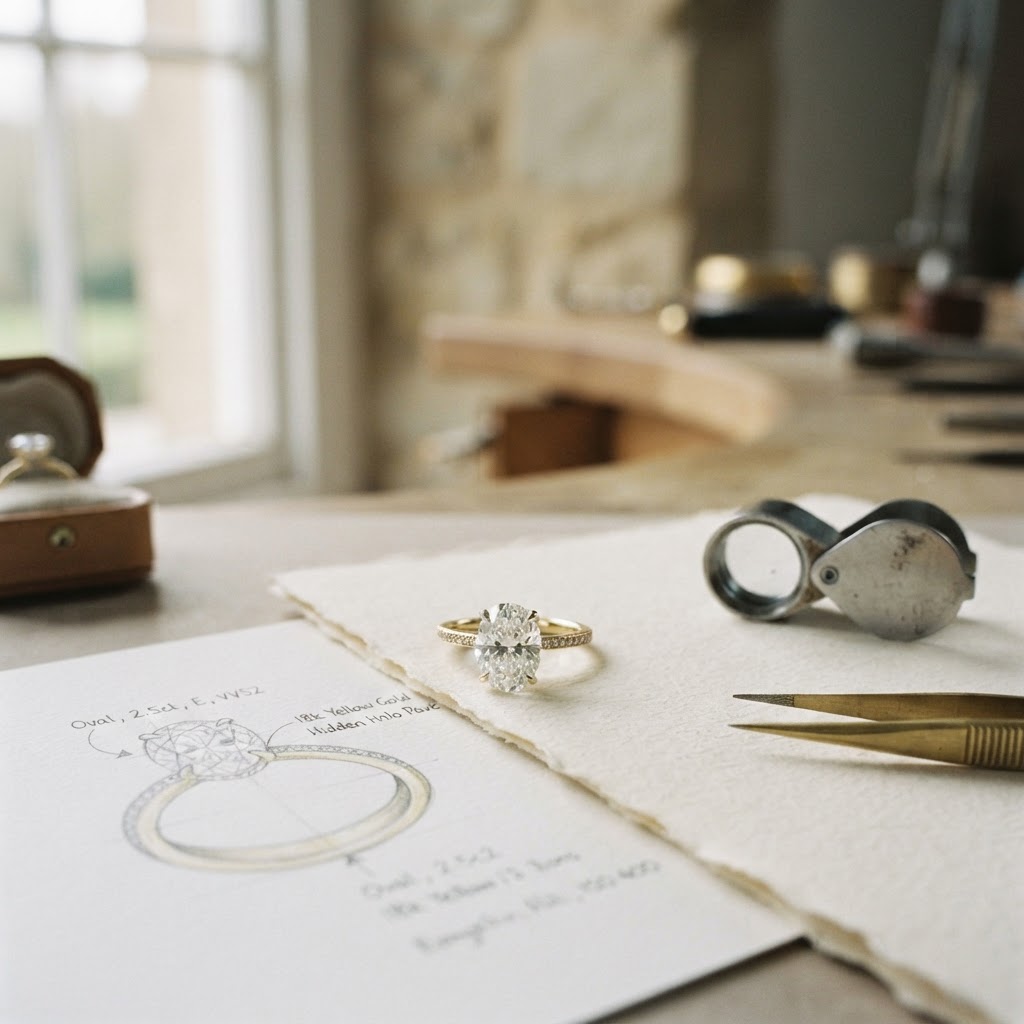
Oval Diamond Engagement Ring UK: Technical Procurement and Design Guide
Selecting an oval diamond engagement ring UK is a complex optimisation problem where geometric ratios must be balanced against reflective...
Selecting an oval diamond engagement ring UK is a complex optimisation problem where geometric ratios must be balanced against reflective performance. Traditional retail models often prioritise emotional narratives over technical data. This approach leads to inefficiencies in value and performance. You likely find that opaque pricing structures and subjective grading make it difficult to identify the highest quality stones. The procurement of a high-performance diamond requires a methodical approach to data management and specification tracking.
We agree that the acquisition process should be transparent and strictly logical. This guide provides a systematic analysis of oval diamond specifications, current UK market pricing, and bespoke configuration protocols for the technical buyer. We will define the parameters for identifying the bow-tie effect and establish ideal length-to-width ratios for maximum light return. The following sections examine GIA and IGI certification standards and the logistics of acquiring loose diamonds. You will gain a clear understanding of the procurement timeline and the protocols for a bespoke design service tailored to specific stone dimensions.
Key Takeaways
- Quantify the visual spread advantage of the oval cut. Ovals offer a 10-15% larger surface area than round diamonds of equivalent carat weight.
- Define aesthetic preferences using the length-to-width ratio. Target ratios between 1.30 and 1.50 to manage the bow-tie effect and silhouette elongation.
- Optimise your acquisition strategy for an oval diamond engagement ring UK by utilising a direct-to-consumer model. This removes traditional retail markups and ensures transparent pricing.
- Evaluate structural configurations for bespoke settings. Select between solitaire mounts for maximum light exposure or hidden halos for structural reinforcement.
- Execute a systematic procurement workflow. Use digital tools like the Diamond Quiz and Ring Maker to map specific data points before finalising loose diamond selection.
Technical Properties of the Oval Cut Geometry
The oval cut is a modified brilliant-cut gemstone. It features an elongated silhouette that creates a unique optical profile. This geometry offers a significant visual spread advantage compared to traditional round cuts. Data suggests that ovals typically appear 10-15% larger than round diamonds of equal carat weight. This makes an oval diamond engagement ring UK an efficient choice for buyers prioritising visible surface area. The elongated shape also facilitates finger-length optimisation. It creates a vertical line that visually extends the appearance of the wearer's finger.
Visual Area vs Carat Weight Efficiency
Surface area is measured in square millimetres (mm²). This metric is more descriptive of a stone's size than carat weight alone. A standard 1.00ct round diamond has a diameter of approximately 6.5mm. This results in a face-up surface area of roughly 33.2mm². A well-proportioned 1.00ct oval diamond often measures 7.7mm by 5.7mm. This yields a surface area of approximately 37.5mm². The oval geometry distributes mass more broadly across the horizontal plane.
Buyers must identify the "carat weight trap" during the procurement process. This occurs when a stone is cut too deep. Deep-cut ovals hide significant mass beneath the girdle where it provides no visual benefit. These stones have a smaller face-up size than their carat weight suggests. You should select stones based on their physical dimensions (length and width) rather than raw carat mass. This ensures you are not paying for hidden weight that does not contribute to the stone's appearance.
The Reflective Index of Elongated Facets
Facet configurations in oval cuts typically include 57 or 58 individual surfaces. This arrangement follows standard diamond cutting principles intended to maximise internal reflection. The primary challenge in oval geometry is maintaining facet alignment across an asymmetrical axis. Because the shape is elongated, facets vary in size and angle from the centre to the tips. This variation requires precise execution to prevent uneven light distribution.
Technical buyers should focus on "Excellent" or "Very Good" grades for both polish and symmetry. High symmetry ensures that facets reflect light consistently across the entire surface. Poor symmetry frequently results in light leakage. This is a common issue in elongated shapes where light escapes through the bottom of the stone instead of reflecting back to the eye. Light leakage creates dull zones that diminish the stone's brilliance. We advise reviewing Loose Diamonds using 360-degree video to confirm that light return is uniform across all facets.
Geometric Grading: Ratio and Bow-tie Analysis
Geometric grading for an oval diamond engagement ring UK prioritises the length-to-width (L/W) ratio. This numerical value defines the stone's silhouette and aesthetic impact. You calculate this by dividing the length measurement by the width. Whilst GIA certificates provide these dimensions, they don't assign a cut grade to ovals. This makes independent geometric analysis essential for the technical buyer. Precise ratio selection ensures the diamond aligns with the intended visual profile and setting configuration.
Ideal Length-to-Width Ratio Parameters
Market standards categorise oval ratios into three distinct aesthetic profiles. Each category influences the stone's performance and how it interacts with the wearer's finger:
- 1.30–1.40 (Classic): This ratio provides a balanced, traditional look. It's the most versatile for solitaire and halo settings.
- 1.40–1.50 (Elongated): These stones appear longer and slimmer. They maximise the finger-slenderising effect and are often preferred for bespoke minimalist designs.
- <1.30 (Wide): These stones have a "chubby" appearance. They offer a larger width but may lack the elegant elongation typically associated with the oval cut.
Ratio selection also dictates side stone compatibility. Classic ratios pair well with round or pear-shaped accents. Highly elongated ratios (>1.50) may present structural risks. These stones can be more susceptible to chipping at the tips if the girdle is too thin. You should review Loose Diamonds data to identify stones that balance length with structural integrity. Whilst geometry defines the stone, the final assembly must adhere to UK Hallmarking Regulations to ensure metal purity and legal compliance.
Mitigating the Bow-tie Phenomenon
The bow-tie effect is a dark area across the centre of the stone caused by light interference. The bow-tie effect is a product of facet misalignment that obscures light return. Every oval diamond exhibits this to some degree, but its prominence varies. GIA and IGI certificates do not explicitly grade this effect. It's a subjective visual characteristic that requires manual verification through 360-degree video data.
To minimise darkness, you should target stones with a depth percentage between 62% and 66%. Stones outside this range often show more pronounced bow-ties due to poor light refraction. Look for stones where the "shadow" disappears as the diamond rotates in high-definition video. If the dark area remains static and opaque, light leakage is excessive. Technical buyers can consult with a specialist to review high-resolution snapshots of specific stones before procurement.
Structural Configurations for Oval Settings
Setting an oval diamond engagement ring UK requires a calculation of structural security against light performance. The elongated silhouette of the oval makes the tips vulnerable to mechanical impact. You must select a configuration that protects these points whilst allowing sufficient light entry to the pavilion. Structural integrity is the primary objective in technical ring design.
Solitaire configurations serve as the technical baseline for minimalist design. This setup maximises light exposure from all angles, enhancing the reflective index. However, the lack of surrounding metal increases the risk of damage to stones with thin girdles. You should evaluate the stone's girdle thickness before committing to a 4-prong solitaire.
Hidden halos provide a modern solution for structural reinforcement. This design incorporates a small ring of diamonds beneath the centre stone. It adds lateral stability to the prongs without obscuring the top-down view of the diamond. For those seeking geometric balance, "Toi et Moi" and "Three-Stone" designs utilise side stones to frame the oval. These configurations distribute the visual weight across the band, which is effective for elongated ratios.
Prong selection is a critical specification. A 4-prong setting is sufficient for classic ratios (1.30–1.40). It provides a clean, unobstructed view of the stone. For highly elongated ratios or diamonds with thin girdles, a 6-prong configuration is recommended. The extra contact points distribute pressure more evenly and offer superior retention. This prevents the stone from rotating or becoming loose within the mount.
Solitaire vs Halo: A Component Analysis
A halo setting provides a perimeter of metal and smaller diamonds around the centre stone. This acts as a physical buffer for the oval's vulnerable tips. It's a high-utility choice for active wearers. Conversely, the solitaire remains the preferred choice for data-driven, minimalist aesthetics. It allows for the most direct measurement of light performance. You can evaluate various head styles and configurations using the Jewellove Ring Maker to determine the optimal balance between security and visibility.
Metal Pairings: Platinum and Gold Specifications
Platinum is the primary technical recommendation for securing loose diamonds. Its density and durability ensure that prongs remain secure over long durations. It's a stable material that does not require frequent replating. This makes it an efficient choice for long-term data management of the piece's structural health.
Yellow gold is an alternative choice but requires careful consideration of diamond colour. Prongs made of yellow gold can reflect warm tones into high-colour (D-F) diamonds, potentially lowering the perceived colour grade. To mitigate this, many bespoke designs use platinum prongs on a gold band. Regular maintenance is essential for all metal types. You should follow established Jewellery Care protocols to monitor prong wear and metal thinning. Regular snapshots of the setting's condition help track the need for professional servicing.
Market Procurement: UK Pricing and Logistics
The procurement of an oval diamond engagement ring UK requires a structured financial model. Traditional retail markups increase costs. They do not add technical value. We utilise a Direct-to-Consumer model to eliminate these inefficiencies. This strategy ensures that capital is allocated to stone quality and metal purity rather than high-street overheads. Systematic budgeting allows for the acquisition of higher-specification loose diamonds within a fixed price range.
Logistics for loose diamond procurement involve specific tax obligations. UK VAT is applied at a rate of 20% for shipments valued above £135. Standard customs duties also apply. Research indicates duty rates for precious metal jewellery are approximately 2%. These figures are mandatory data points for your initial budget calculations. Precise data management prevents unexpected costs during the final acquisition phase. Lanarkshire serves as the regional hub for our bespoke consultations and logistics management. This location facilitates secure handling and local oversight of the manufacturing process.
Budgeting for Metal Volatility
Platinum and gold prices fluctuate daily based on global market data. These variations affect the final quote for a bespoke setting. You should request a "Platinum Price Snapshot" to establish a baseline for your budget. We recommend locking in metal prices during the design phase to prevent cost overruns. This ensures your project remains within the defined financial parameters. Use the Loose Diamonds database to track stone price trends. Identifying optimal procurement windows is essential for cost efficiency.
Lanarkshire Bespoke Logistics
The timeline from initial consultation to final delivery typically spans several weeks. This period includes stone selection, CAD design, and hallmarking. We employ strict "Measurement and Verification" protocols to ensure fit accuracy. Use a professional ring sizer for initial data collection. This reduces the risk of resizing requirements after the build is complete. The Jewellove Heritage of local craftsmanship dates back to 2009. This history provides a reliable framework for executing complex bespoke projects. Local logistics ensure that every stage of the build is tracked and verified against your specific requirements.
Implementation: The Jewellove Bespoke Protocol
The Jewellove Bespoke Protocol is a four-phase technical workflow. It organises the procurement of an oval diamond engagement ring UK into a series of verifiable steps. This systematic approach ensures that every design decision is backed by data and structural logic. We prioritise the clarity of information throughout the configuration process.
Phase 1 focuses on data acquisition. You use the Diamond Quiz to define your specific performance parameters and aesthetic requirements. This provides the baseline for the entire project. Phase 2 involves geometric ratio mapping. You select from the Loose Diamonds inventory using the length-to-width metrics established in previous sections. Phase 3 transitions to technical CAD design. This phase converts your selected specifications into a precise 3D digital model for review. Phase 4 is fabrication. Our Lanarkshire-based facility manages the assembly, hallmarking, and final quality control protocols.
Using the Ring Maker Interface
The Ring Maker tool functions as a digital configuration engine for initial design snapshots. Users can toggle between various oval dimensions and metal types in real-time. This interface allows for the side-by-side comparison of multiple configurations. You can evaluate how a 1.45 ratio interacts with a platinum solitaire mount versus a yellow gold hidden halo. This data-driven approach eliminates the uncertainty of traditional retail browsing. Use the tool to initiate your workflow and generate a preliminary specification list for specialist review.
Professional Design Consultations
A Bespoke Design Service specialist reviews every configuration for structural viability. This consultation phase integrates your specific data points into the final CAD model. Specialists verify that prong placement and metal thickness align with the diamond's unique geometry and girdle thickness. This step is essential for ensuring long-term security and light performance.
Final verification steps include a 360-degree review of the digital render. This ensures all parameters meet the established criteria before the manufacturing phase begins. You receive a technical summary of the piece's dimensions and metal weight. The process concludes with a physical inspection at our Lanarkshire centre to confirm hallmarking compliance and stone security. This rigorous protocol has been the standard for our bespoke operations since 2009.
Optimising Your Procurement Workflow
The procurement of an oval diamond engagement ring UK requires a transition from subjective preference to technical specification. You have identified the critical parameters for geometric mapping; this includes the mitigation of the bow-tie effect and the optimisation of length-to-width ratios. These data points form the foundation of a high-performance build. Our direct-to-consumer model ensures that your budget is allocated to material quality and precision engineering rather than retail markups. This systematic approach has defined our data-driven diamond procurement protocols since 2009.
By utilising specialists in Lanarkshire bespoke jewellery, you ensure that every configuration meets strict structural and legal standards. The final CAD model serves as a verifiable snapshot of your unique requirements before fabrication begins. This methodology guarantees a final product that aligns with your specific technical goals. We provide the tools and expertise to manage this complex acquisition with absolute clarity.
We look forward to facilitating your bespoke project with precision and efficiency.
Frequently Asked Questions
Are oval diamond engagement rings more expensive in the UK?
Oval diamonds are generally less expensive than round brilliant cuts of equivalent carat weight. Data indicates a price differential of 10-20% depending on the specific quality of the stone. Our direct-to-consumer model in Lanarkshire eliminates traditional high-street markups to ensure maximum value. UK buyers must account for 20% VAT and roughly 2% customs duty on imports. These costs apply to all diamond shapes and are not specific to the oval cut.
What is the ideal length-to-width ratio for an oval diamond?
The ideal length-to-width ratio for an oval diamond typically ranges between 1.35 and 1.50. Ratios within the 1.30 to 1.40 range provide a classic, balanced silhouette. Elongated profiles usually fall between 1.40 and 1.50. Ratios below 1.30 result in a wider, shorter appearance. You should select a ratio based on the intended visual spread and setting configuration. This data point is critical for ensuring the diamond aligns with bespoke design parameters in Lanarkshire.
Do all oval diamonds exhibit a bow-tie effect?
All oval diamonds exhibit some degree of the bow-tie effect due to their facet arrangement. This phenomenon appears as a dark area across the centre of the stone. The visibility of this effect depends on the precision of the cut and the depth percentage. Technical buyers should target stones with a depth between 62% and 66% to minimise this interference. Verification via 360-degree video is essential to confirm the bow-tie is not opaque or distracting.
Does an oval diamond look larger than a round diamond of the same carat?
An oval diamond provides a 10-15% larger face-up surface area than a round diamond of identical carat weight. This visual spread advantage results from the elongated geometry distributing mass across a broader horizontal plane. It is an efficient choice for those prioritising visible size. You should evaluate the millimetre dimensions rather than the carat mass to determine the true visual impact of an oval diamond engagement ring UK.
Which metal is best for an oval engagement ring setting?
Platinum is the primary technical recommendation for securing oval diamonds. Its high density and durability ensure that prongs remain secure over long durations. This is particularly important for protecting the vulnerable tips of the oval silhouette. Whilst gold is an alternative, we specialise in platinum at our Lanarkshire facility. We provide the most stable structural configurations for bespoke projects to manage the long-term integrity of the setting and the security of the stone.
Can I design my own oval engagement ring online?
You can design a bespoke ring using our digital configuration tools. The Ring Maker interface allows you to toggle between different oval dimensions and metal types in real-time. This tool functions as a digital facilitator for initial design snapshots and comparison. You can map specific data points and generate a preliminary specification list. Every online configuration undergoes a professional review by our Lanarkshire specialists to ensure structural viability and technical precision.
How long does the bespoke ring design process take in Lanarkshire?
The bespoke ring design process in Lanarkshire typically spans several weeks from the initial consultation to final delivery. This timeline includes stone procurement, technical CAD modelling, and hallmarking protocols. Each phase is tracked to maintain logistical efficiency and quality control. Local oversight at our Lanarkshire facility ensures that every stage of the build meets our established standards. You will receive a clear procurement timeline once your specific configuration and diamond selection are finalised.