Diamond Certification Guide UK: Technical Grading and Procurement Protocols
For wholesale lab-grown diamonds in the 0.5 to 1 carat range, certification costs can represent up to 12% of the total wholesale price. This data...
For wholesale lab-grown diamonds in the 0.5 to 1 carat range, certification costs can represent up to 12% of the total wholesale price. This data point identifies the certificate as a significant financial component of the asset rather than a supplementary document. Most procurement errors stem from a lack of standardisation across different grading laboratories, leading to inflated prices for sub-standard stones. This diamond certification guide uk provides a clinical framework for interpreting diamond grading reports to ensure technical precision and value optimisation. It establishes a clear hierarchy of laboratory reliability and outlines a systematic protocol for reading GIA or IGI dossiers. This guide details how to verify a physical stone against its digital snapshots and how to handle technical data for the Ring Maker tool. The content also addresses essential UK procurement factors, including the 20% VAT on imports and the specific documentation required to comply with current Russian diamond sanctions. Use this information to categorise data effectively and eliminate the risks associated with loose diamond acquisition.
Key Takeaways
- Differentiate technical grading reports from subjective appraisals to establish a baseline for asset valuation.
- Categorise global laboratories by stringency levels to mitigate the risk of grade inflation in colour and clarity.
- Use this diamond certification guide uk to map proportional data such as depth and crown angles for precise light performance analysis.
- Implement verification protocols to cross-reference physical laser inscriptions with digital dossiers before completing procurement.
- Input certification data directly into the Ring Maker tool to ensure technical compatibility with bespoke platinum settings.
The Architecture of Diamond Certification: Technical Parameters
A diamond grading report functions as a technical blueprint. It provides a data-led snapshot of a stone's physical properties. Within this diamond certification guide uk, certification is defined as a documented verification of a diamond's anatomical characteristics. It's not a marketing asset. It is a procurement protocol. This document ensures that the specifications of a loose diamond are verified by a neutral third party before it enters the supply chain.
Procurement requires a clear distinction between certified stones and appraised jewellery pieces. A certificate records physical data points. An appraisal estimates a monetary value in British Pound (£) for insurance purposes. These functions are separate. Technical data remains static whilst market values fluctuate based on UK economic conditions. Relying on appraisals for technical verification often leads to overpayment for stones with inflated grades.
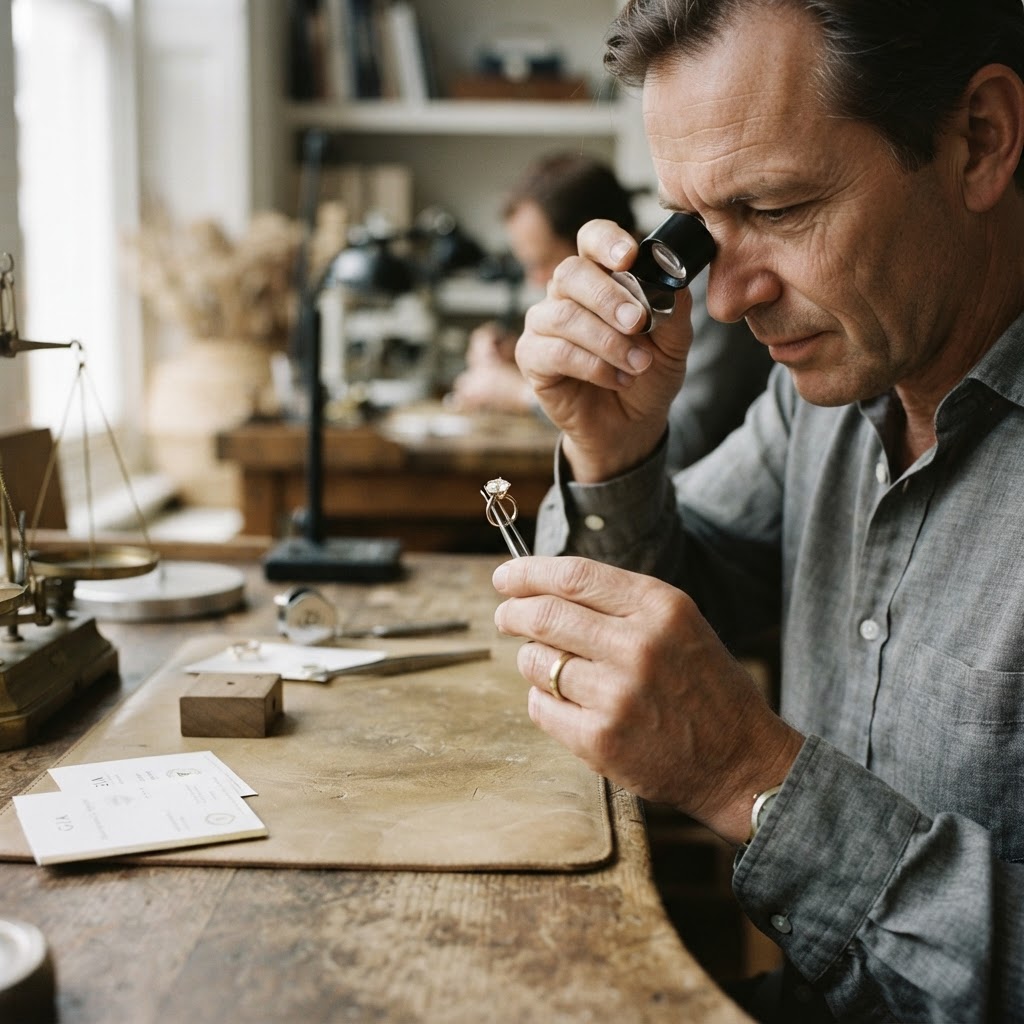
Establishing 4Cs parameters relies on submicroscopic analysis. Technicians use 10x magnification and specialised microscopy to map internal inclusions and surface blemishes. This Diamond Clarity Grading process ensures that every microscopic feature is categorised within a global standard. This data is essential for accurate value optimisation. It allows for the systematic comparison of stones based on objective physical evidence rather than subjective visual assessments.
Defining the Grading Report
Technical dossiers function as statements of fact. They do not provide an estimate of value. Every report contains a unique identification number. This number is often laser-inscribed on the diamond's girdle for total traceability. Neutrality is a requirement for the issuing laboratory. The facility must have no financial interest in the final retail price of the stone. Standardisation across these reports allows for efficient inventory management.
- Unique ID: Facilitates digital tracking and verification against global databases.
- Physical Plot: A graphical map of clarity characteristics and inclusion locations.
- Proportion Data: Precise measurements of table percentage, depth, and facet angles.
The Role of Independent Verification
Laboratories maintain an objective distance from retail transactions. This detachment prevents grade inflation and ensures data integrity. Non-biased data stabilises the global trading market. It allows for the comparison of loose diamonds across different digital platforms without physical inspection. Jewellove prioritises stones with rigorous independent dossiers. This approach ensures that the data input for the Ring Maker tool is accurate and verifiable.
Reliable certification is a prerequisite for high-value procurement in the UK. It ensures compliance with the 20% VAT on imports and current Russian diamond sanctions. These regulations require evidence of the supply chain for diamonds equal to or larger than 0.5 carats. Independent dossiers provide the technical snapshots needed for customs declarations. This diamond certification guide uk emphasises that independent data protects against overpayment for stones with inflated grades. It establishes a logical foundation for bespoke design and asset management.
Analysis of Global Grading Laboratories: Data Reliability Standards
Laboratory reliability is the primary variable in diamond valuation. In the UK market, the Gemological Institute of America (GIA) and the International Gemological Institute (IGI) represent the majority of available data. This diamond certification guide uk identifies a clear hierarchy where GIA remains the benchmark for conservative grading. Technical variance occurs because laboratories apply different tolerance thresholds for clarity and colour. A stone graded 'G' by a lenient laboratory might only achieve an 'I' under stricter protocols. This discrepancy directly impacts the procurement price in British Pound (£). Reliable data requires a standardisation that only top-tier laboratories provide.
GIA vs. IGI: A Comparative Framework
GIA is the gold standard for consistent grading. Their protocols are historically conservative, making GIA reports the preferred choice for investment-grade natural stones. IGI has established a dominant position in lab-grown diamond certification. Research from August 2026 indicates IGI lab-grown reports cost approximately £50 to £80 per stone. GIA reports for similar lab-grown stones cost approximately £70 to £100. Procurement bids must reflect these differences. A GIA-certified stone often carries a price premium because the data is perceived as more reliable by global traders. Buyers should adjust their value expectations based on which laboratory issued the technical dossier.
Other institutions utilise different metrics to evaluate stones. The AGS Diamond Grading System uses a 0 to 10 scale to measure light performance and cut quality. Whilst less common in the UK high street, understanding these alternative scales is vital for comparing loose diamonds across international platforms. Use the Jewellove Ring Maker to filter stones by laboratory to ensure data consistency in your design process. This tool allows for the systematic organisation of stones based on their specific grading report parameters.
Secondary Laboratories and Data Variance
HRD Antwerp is a significant secondary laboratory within Europe. It is respected amongst collectors for its technical standing, though its colour grading nuances differ from GIA standards. Extreme caution is required when encountering "in-house" certificates. These documents lack third-party neutrality. They often serve as marketing tools rather than objective technical blueprints. Local, unaccredited laboratories frequently provide inflated grades to justify higher retail prices. Establish a strict protocol for rejecting data from any source that cannot demonstrate a history of independent, global standardisation. Procurement should focus on GIA, IGI, or HRD to ensure the technical snapshot matches the physical asset.
Deciphering the Grading Dossier: A Systematic Data Mapping
A GIA dossier is a data matrix. It organises complex physical attributes into a standardised format. This diamond certification guide uk treats the report as the primary data input for procurement. Users must navigate the technical sections with precision to avoid value leakage. The document categorises the 4Cs but also provides the geometric measurements required for light performance modelling. Systematising this data allows for a clinical comparison of stones across different digital inventories.
Geometric and Proportional Analysis
Proportional data dictates the refractive index and light return of the stone. The table percentage and total depth percentage are critical metrics. For a standard round brilliant, a table between 54% and 57% is often optimal for balancing brilliance and fire. Depth should ideally fall between 59% and 62.5%. Deviations from these ranges impact the stone's ability to reflect light efficiently. These numbers are more descriptive than a simple "Excellent" grade.
The "Cut Grade" provides a summary, but the underlying geometry offers deeper insight. Crown and pavilion angles must work in synergy. A crown angle of 34 to 35 degrees combined with a pavilion angle of 40.6 to 40.9 degrees is a common high-performance configuration. This data also allows users to predict the "face-up" size. Carat weight is a measure of mass, not dimensions. Two stones of identical weight can have different millimetre diameters. A "shallow" stone may appear larger but will suffer from light leakage. Use the Ring Maker tool to input these specific millimetres to ensure structural compatibility with platinum settings.
Mapping Internal and External Characteristics
The clarity plot is a graphical representation of the stone's internal and external features. It uses standardised symbols to identify crystals, feathers, and clouds. Crystals are mineral inclusions. Feathers are small fractures. Clouds are clusters of microscopic pinpoints. The location of these features is as important as their type. Inclusions located directly under the table are more visible than those near the girdle. Categorise these features based on their impact on light path interference.
The "Comments" section contains data not captured in the visual plot. Notes such as "Surface graining is not shown" or "Clarity grade is based on clouds that are not shown" indicate characteristics that may affect transparency. Distinguish between identifying marks and structural defects. A small crystal is an identifier. A large feather reaching the surface may be a structural risk. Systematically mapping this data ensures that the procurement process remains objective and logic-driven. Verification of the laser inscription on the girdle completes the protocol, linking the physical asset to its digital dossier.
Procurement Strategy: Optimising Value Through Certification Data
Certification parameters function as the primary variables in price-setting algorithms. Market liquidity in the UK depends on the standardisation of this data. GIA-certified stones maintain a higher resale efficiency because their grading protocols are universally recognised as conservative. This diamond certification guide uk identifies fluorescence as a key technical variable. Whilst strong fluorescence can impact the transparency of high-colour stones, it often results in a price discount that does not affect visual performance in lower colour grades. Categorising these variables allows for the systematic optimisation of procurement costs. A data-led approach ensures that the buyer pays for physical performance rather than lab-issued labels.
Economic analysis shows that technical specifications dictate the market price snapshot at any given time. In the UK, the 20% VAT on imports makes value optimisation even more critical. Buyers must distinguish between "buying the stone" and "buying the certificate". A stone with a slightly lower clarity grade but a superior cut often provides better optical performance than a higher-clarity stone with poor proportions. Identifying these discrepancies is the core of a professional procurement strategy. It turns the certification from a passive document into an active tool for financial management.
Identifying Value Gaps in Technical Specs
Strategic selection involves finding stones where technical specs exceed the price bracket. A "Very Good" cut grade can offer identical refractive efficiency to an "Excellent" grade if the table and depth percentages align with the parameters mentioned in section 3. This creates a value gap. Price discounts also apply to specific inclusion types. Crystals located near the girdle are less detrimental to light return than those under the table but carry a similar technical grade. Categorising inclusions based on their location allows for the acquisition of "eye-clean" stones at a lower price point. Use the Jewellove Ring Maker to compare these data snapshots and identify stones with optimal price-to-performance ratios.
Economic Impact on Resale and Insurance
UK insurance providers require independent certification for assets exceeding specific value thresholds. A grading dossier provides the objective evidence needed for correct premium calculation. It serves as the definitive reference point during future appraisals or resale events. Maintaining a digital archive of these reports is essential for asset management. This documentation ensures that the physical stone remains linked to its verified data profile throughout its lifecycle. Correct documentation also facilitates compliance with UK customs and VAT regulations for imported stones. A GIA or IGI dossier is a prerequisite for verifying the supply chain, which is mandatory under current UK sanctions on Russian diamonds for stones over 0.5 carats.
Verification Protocols: Integrating Certification into Bespoke Design
Verification is the final stage of the procurement protocol. The Jewellove Ring Maker functions as the digital interface for this process. It allows users to map diamond dimensions directly to platinum structural specifications. This synergy ensures that the stone's physical parameters, as recorded in the GIA or IGI dossier, are compatible with the chosen setting. This diamond certification guide uk emphasises that technical compatibility is a prerequisite for a stable bespoke design. Data integration prevents structural failure and ensures that the finished asset aligns with the initial technical intent.
Utilising the Jewellove Ring Maker Interface
The Ring Maker tool facilitates the systematic filtering of loose diamond availability. Input specific 4Cs data to narrow the inventory to stones that meet your technical requirements. The interface organises design snapshots for efficient comparison. This feature allows users to evaluate how different certification outcomes affect the final design. Mapping diamond dimensions in millimetres is a critical step. These measurements dictate the proportions of the platinum head and the placement of the claws. Accurate data input via the Ring Maker ensures a precise fit and avoids the need for structural adjustments during the assembly phase.
Lanarkshire Procurement and Verification
Physical verification protocols occur in Lanarkshire. Request a technical consultation to cross-reference the physical stone with its digital dossier. Use a 10x loupe to identify the laser inscription on the diamond's girdle. This identifier must match the report number exactly. Verify the location of clarity characteristics against the plot provided in the grading report. This systematic check confirms that the asset in hand is the one described in the technical documentation. It eliminates the risk of stone switching and ensures data integrity before the design is finalised.
- In-Person Review: Inspect the stone under neutral lighting to confirm colour consistency.
- Inscription Check: Use magnification to read the GIA or IGI report number on the girdle.
- Plot Verification: Map internal inclusions to ensure they match the laboratory's diagram.
Finalise the bespoke design by ensuring the hallmarking matches the technical intent. UK law requires that all platinum items are hallmarked at an independent Assay Office. This process verifies the metal purity and provides a permanent record of the item's origin. The hallmark acts as a secondary layer of certification for the finished piece. Systematic assembly follows these verification steps. The result is a piece of jewellery where every component is backed by verified data. This logic-driven approach to the diamond certification guide uk ensures that the final product is a precise physical representation of the procurement data.
Implementing a Data-Driven Procurement Protocol
Diamond certification is a technical requirement for high-value asset acquisition. This diamond certification guide uk establishes the framework for interpreting grading dossiers and identifying strategic value gaps. Standardised reports from GIA or IGI ensure that your procurement remains objective and logic-driven. Integrating this technical data into the Ring Maker tool facilitates a precise bespoke design process. This system ensures that every physical attribute is verified against a digital blueprint before assembly.
Utilise clinical data management to eliminate the risks associated with subjective high-street sales tactics. Direct-to-consumer pricing models provide transparent access to global inventory whilst removing unnecessary retail markups. Physical verification protocols in Lanarkshire complete the data cycle by linking the stone to its dossier. This methodical approach protects your investment and ensures technical precision in every bespoke platinum piece.
Procure your loose diamond with technical precision at Jewellove. Start your systematic design process today.
Frequently Asked Questions
What is the most recognised diamond certification in the UK?
The Gemological Institute of America (GIA) is the most recognised benchmark in the UK. It's considered the gold standard for conservative grading protocols. Most high-value procurement in the UK jewellery industry relies on GIA data for natural stones. This diamond certification guide uk identifies GIA as the primary source for consistent 4Cs mapping. IGI is also widely recognised, specifically for lab-grown diamond data management and high-volume inventory snapshots.
Does a diamond certificate expire or need to be renewed?
Diamond certificates don't have an expiry date. The technical data remains a permanent record of the stone at the time of grading. However, physical alterations can occur over time. Surface scratches or nicks acquired through wear can change the clarity grade. If a stone is chipped, the original report is no longer an accurate technical blueprint. Procurement of older stones often requires a fresh grading dossier to verify current physical integrity.
Can I verify a GIA certificate online using the report number?
Every GIA report includes a unique identification number for digital verification. Access the GIA Report Check tool online to input this number. The system retrieves a digital snapshot of the original dossier for cross-referencing. This protocol ensures that the physical report matches the official laboratory database. It's a critical step in the verification process. Use this tool to confirm the technical specifications before finalising any bespoke design through the Ring Maker.
Is an IGI certificate less accurate than a GIA certificate?
IGI is not inherently less accurate, but it operates with different tolerance thresholds. GIA is historically more conservative in its colour and clarity assessments. This difference often results in a price premium for GIA-certified stones in the UK market. IGI is a market leader for lab-grown diamonds, providing detailed data at a lower certification cost. Procurement bids should always account for the specific laboratory's grading tendencies to ensure value optimisation.
How does diamond fluorescence affect the grading report data?
Fluorescence is a technical variable recorded in the grading report. It describes the stone's reaction to ultraviolet light. High levels of fluorescence can make a diamond appear hazy or milky in natural sunlight. This optical performance issue often results in a price discount in the UK market. Conversely, faint fluorescence can improve the visual colour of stones in lower colour grades. Categorise this data to determine its impact on the asset's liquidity.
What is the difference between a full grading report and a dossier?
A full grading report includes a clarity plot that maps the location of all inclusions. A dossier is a condensed version of this data, typically issued for stones under 1.00 carat. Dossiers omit the graphical plot but include a mandatory laser inscription on the diamond's girdle. This diamond certification guide uk recommends dossiers for smaller stones to facilitate easy identification. Larger assets usually require the full technical mapping provided by a complete report.
Why do some diamonds have a laser inscription and others do not?
Laser inscriptions are security protocols used to link a physical stone to its digital dossier. Most modern diamonds graded by GIA or IGI include an inscription of the report number on the girdle. Older stones or those with full reports might not have an inscription unless specifically requested. An inscription allows for rapid verification using a 10x loupe. It's a prerequisite for systematic procurement and ensures the stone hasn't been substituted during assembly.
Does certification include a valuation of the diamond in Pounds Sterling?
Certification doesn't include a valuation in British Pound (£). A grading report is a technical blueprint that records physical characteristics. It's a statement of fact, not an estimate of market value. Monetary appraisals are separate documents issued by independent valuers for insurance purposes. Use the technical data in the report to determine the market price snapshot. The certificate provides the data inputs required for the Ring Maker tool during bespoke design.